
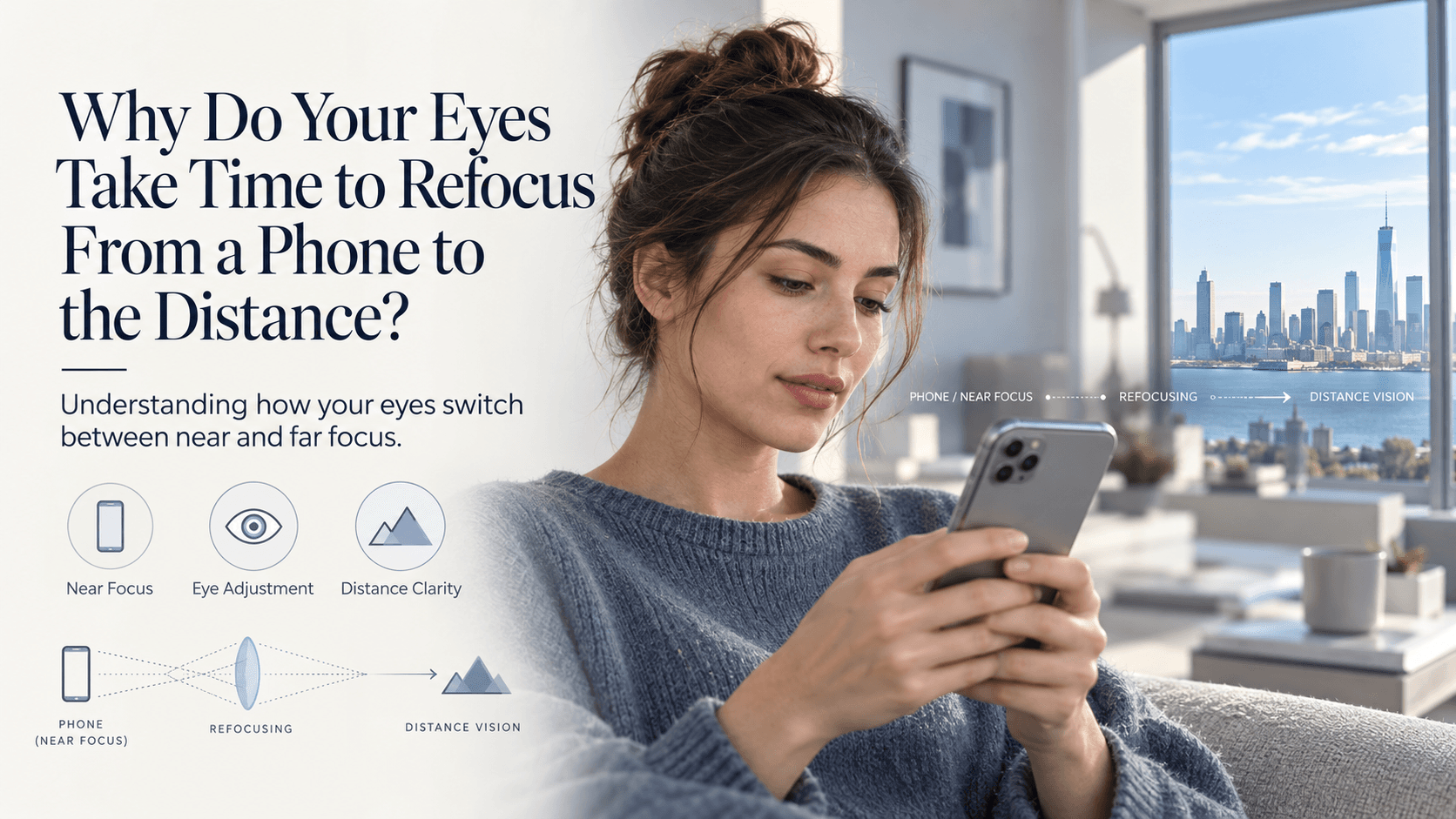
Why Do Your Eyes Take Time to Refocus From a Phone to the Distance?
You spend 30 minutes scrolling through your phone.
Then you look across the room.
For a moment, the television, clock or person across from you looks slightly blurry.
You blink a few times, wait a second or two—and suddenly everything becomes clear again.
It can feel as though your eyes need to “reset” after using your phone.
In many cases, that sensation is related to the normal focusing system of the eye, particularly after prolonged close-up work.
But frequent or persistent difficulty shifting focus can also be influenced by digital eye strain, dry eyes, your prescription or age-related changes in focusing ability.
Understanding what your eyes are doing can help explain why.
Your Eyes Are Constantly Refocusing
A smartphone camera automatically changes focus depending on what you're photographing.
Your eyes perform something similar.
When you look at something close, such as your phone, the lens inside your eye changes its focusing state so that the image remains clear.
When you look across the room, the focusing system has to adjust again.
This process is called accommodation.
The National Eye Institute describes accommodation as the eye's ability to change focus between distant and nearby objects through changes in the shape of the lens. The lens works together with the cornea to focus incoming light onto the retina.
Usually, this happens so quickly that you don't notice it.
But sometimes the transition feels slower.
Why Your Phone Makes Your Eyes Work Harder
Consider the difference between looking at:
a building 50 metres away
and
a phone 30–40 centimetres from your face.
The closer object places greater demand on your near-focusing system.
During a quick text message, that isn't usually a problem.
But now imagine maintaining that close focus while:
scrolling social media
reading messages
watching videos
shopping online
gaming
reading articles
for an hour or longer.
Your focusing system has been continuously engaged at close range.
When you suddenly look toward something far away, it must relax and change its focusing state.
That transition can sometimes produce a brief period of blur.
Long Periods of Near Work Can Cause Eye Strain
Phone use isn't the only activity capable of doing this.
Prolonged:
reading
studying
laptop work
drawing
sewing
gaming
can produce similar symptoms.
Eyestrain can include tired or sore eyes, blurred or double vision, headaches and difficulty concentrating. Extended digital-device use is a common trigger, although eyestrain itself generally doesn't cause serious long-term consequences.
That means temporary trouble refocusing after a long phone session may be part of a broader digital eye strain pattern.
Reduced Blinking Can Make the Blur Worse
Your focusing system isn't the only thing involved.
When people concentrate on screens, they often blink less frequently.
Blinking redistributes tears over the front of the eye and helps maintain a smooth optical surface.
When blinking decreases, the eyes can become dry.
And when the tear film becomes unstable, vision may fluctuate.
You may notice:
blur → blink → clearer vision
If blinking seems to improve your vision immediately, dryness may be contributing along with focusing fatigue.
Mayo Clinic notes that people often blink less while working at a computer and that reduced blinking can contribute to dry-eye symptoms.
Your Prescription Can Affect Refocusing Too
Sometimes the phone isn't the entire problem.
An uncorrected refractive error may make the visual system work harder than necessary.
Examples include:
Farsightedness
Farsightedness can make near vision more demanding because the eye may need additional focusing effort.
Astigmatism
Astigmatism can cause blurred or distorted vision at both near and far distances.
Nearsightedness
Nearsightedness primarily makes distant objects blurry, meaning you may especially notice the problem when looking away from your phone.
The National Eye Institute explains that refractive errors occur when the eye does not focus light correctly on the retina.
If your distance vision stays blurry rather than clearing quickly, don't automatically blame screen time.
Your prescription may simply need checking.
Age Can Change How Quickly You Focus
Focusing flexibility isn't constant throughout life.
As people get older, the natural lens becomes less flexible.
Eventually this produces presbyopia, the age-related reduction in the ability to focus clearly at close distances.
Presbyopia commonly becomes noticeable in the 40s and gradually progresses.
Someone entering this stage may notice that switching between:
phone → monitor → distance
doesn't feel as effortless as it once did.
They may also start:
holding the phone farther away
increasing text size
needing brighter lighting
developing headaches after near work
An eye examination can determine whether reading, computer or progressive lenses might help.
Does Holding Your Phone Too Close Matter?
Potentially.
The closer you hold an object, the greater the focusing demand.
People also tend to bring phones closer when:
text is too small
lighting is poor
their prescription isn't optimal
they're tired
Instead of moving your phone closer, increase the text size when possible and use a comfortable viewing distance.
The goal isn't to find one mathematically perfect distance—it is to avoid spending hours with the phone unnecessarily close to your eyes.
Give Your Eyes Opportunities to Change Focus
One simple strategy is to regularly look away from your screen.
The commonly recommended 20-20-20 rule suggests that every 20 minutes, you look at something about 20 feet away for at least 20 seconds. Mayo Clinic recommends regular screen breaks and this technique as a way to reduce eyestrain.
You don't have to treat 20-20-20 like a stopwatch.
The useful principle is:
Don't hold your visual system at one close distance for hours without interruption.
Look through a window.
Look across the office.
Stand up.
Walk around.
Blink several times normally.
Give your eyes a chance to switch tasks.
When Is Slow Refocusing Worth Getting Checked?
A few seconds of occasional blur after prolonged close work can be very different from persistent vision problems.
Consider arranging an eye examination if:
distance blur occurs frequently
your vision remains blurry for several minutes
symptoms are getting progressively worse
one eye behaves differently from the other
you experience recurring headaches
you regularly squint to see distant objects
reading has become unexpectedly difficult
you have double vision
your current prescription is several years old
Seek prompt medical attention for sudden or major changes in vision rather than assuming they are related to your phone.
The Bottom Line
Your eyes aren't actually “stuck” on your phone.
They're performing a sophisticated focusing adjustment.
When you've spent a long time concentrating on something close, the shift back toward distance vision may occasionally feel less instantaneous.
Near-focusing demand, digital eye strain, reduced blinking, dryness and an outdated prescription can all contribute.
If the blur disappears quickly and only happens after intensive close work, giving your eyes regular distance breaks may help.
But if your vision remains blurry, the delay becomes increasingly noticeable or it happens even without prolonged phone use, an eye examination is the better next step.
Your phone may reveal the symptom.
It isn't necessarily the entire cause.
