
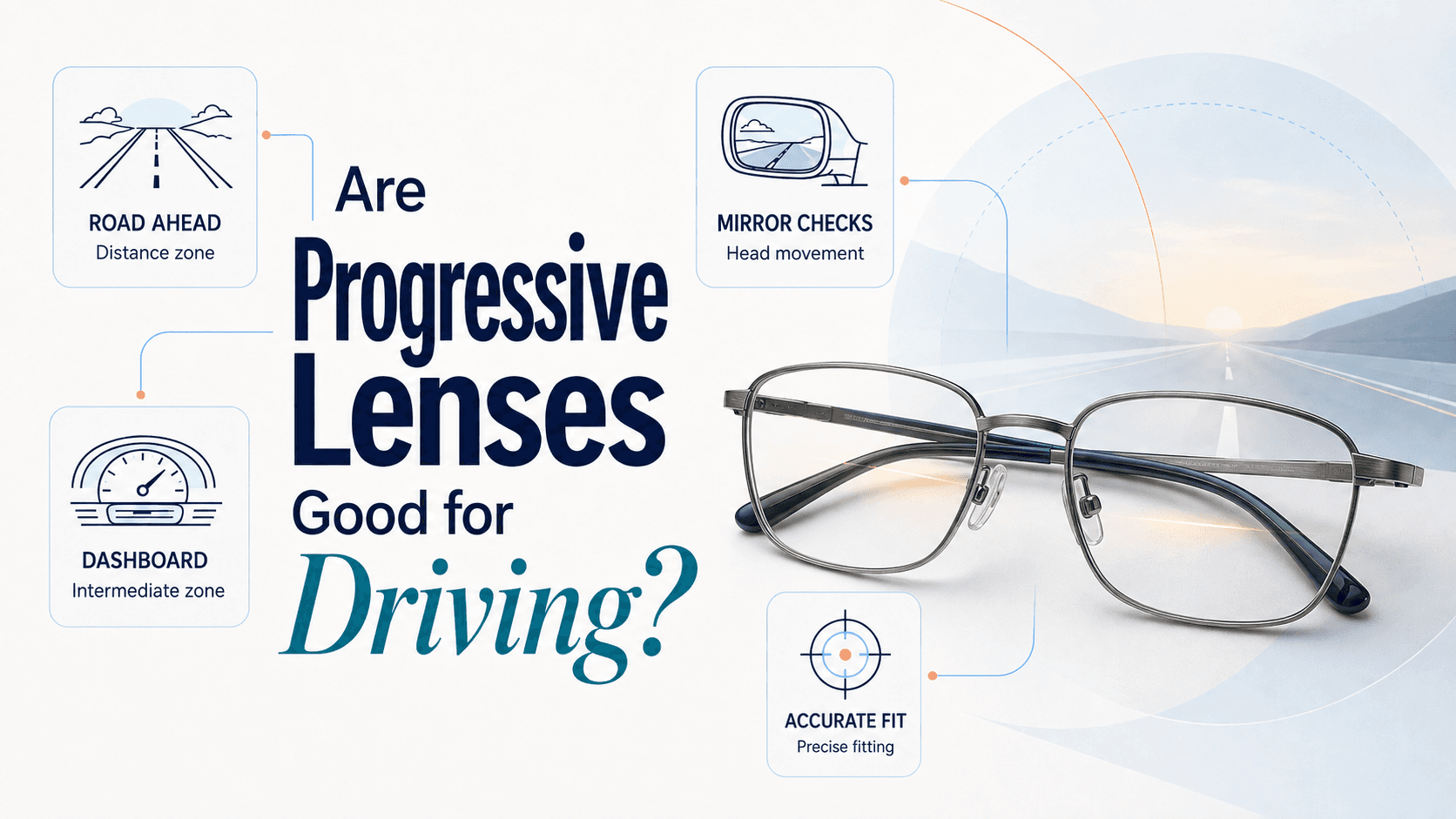
Progressive lenses are generally safe and effective for driving, provided you have adapted to them and your prescription is correctly fitted. They eliminate the need to switch between separate pairs of glasses, but the peripheral distortion in the lens design requires some adjustment — especially when checking mirrors or making quick head movements on busy Indian roads.
How Do Progressive Lenses Work While Driving?
A progressive lens has three vision zones blended seamlessly into one lens: the top portion for distance vision, the middle corridor for intermediate range, and the bottom segment for near vision. When driving, you primarily use the upper distance zone to see the road ahead and your dashboard falls within the intermediate zone. The key skill is learning to position your eyes correctly within the lens to access each zone without moving your head excessively.
What Are the Challenges of Driving with Progressives?
The main concern for drivers is the peripheral distortion — sometimes called swim effect — that exists along the edges of progressive lenses. This can make objects at the side appear to swim or blur slightly, which matters when checking side mirrors or lane-changing. Most wearers adapt within two to four weeks of regular use. First-time progressive wearers should avoid night highway driving until they feel fully comfortable.
Are Progressive Lenses Better Than Bifocals for Driving?
For driving specifically, progressives have a clear advantage over bifocals. Bifocals have a visible line that creates an abrupt jump in vision, which can be distracting and even disorienting when glancing between the road and mirrors. Progressives offer a smoother, more natural transition. However, some drivers who struggle with the adaptation period prefer single-vision distance glasses kept exclusively for driving.
Tips to Drive More Safely with Progressive Lenses
Always ensure your progressive prescription is up to date before long drives — an outdated prescription worsens distortion.
Choose high-index or anti-reflective coated lenses to reduce glare from headlights and streetlights at night.
Turn your head, not just your eyes, when checking mirrors — this keeps your line of sight within the clearer central corridor of the lens.
Allow at least two to four weeks of everyday wear before driving on expressways or in heavy traffic.
Consider polarised progressive sunglasses for daytime driving to reduce road glare effectively.
When Should You Avoid Progressives for Driving?
If you experience persistent dizziness, nausea, or severe swim effect beyond four weeks of wear, consult your optometrist. A lens that is poorly fitted — incorrect pupillary distance or wrong fitting height — is often the culprit rather than progressive lenses themselves. A proper fitting resolves most adaptation problems. In rare cases, a single-vision distance lens may be recommended for driving only.
Choosing the Right Pair for Indian Driving Conditions
Indian roads present unique challenges: variable lighting, glare-heavy afternoons, dusty highways, and night driving with oncoming high-beam traffic. For these conditions, look for progressive lenses with a premium anti-reflective coating and UV400 protection. Wider corridor designs from premium lens series also reduce the narrow swim zone, making them better suited for frequent drivers. At Rimloo, you can explore a range of prescription eyeglasses built for everyday Indian wear, including options designed with driving comfort in mind.
