
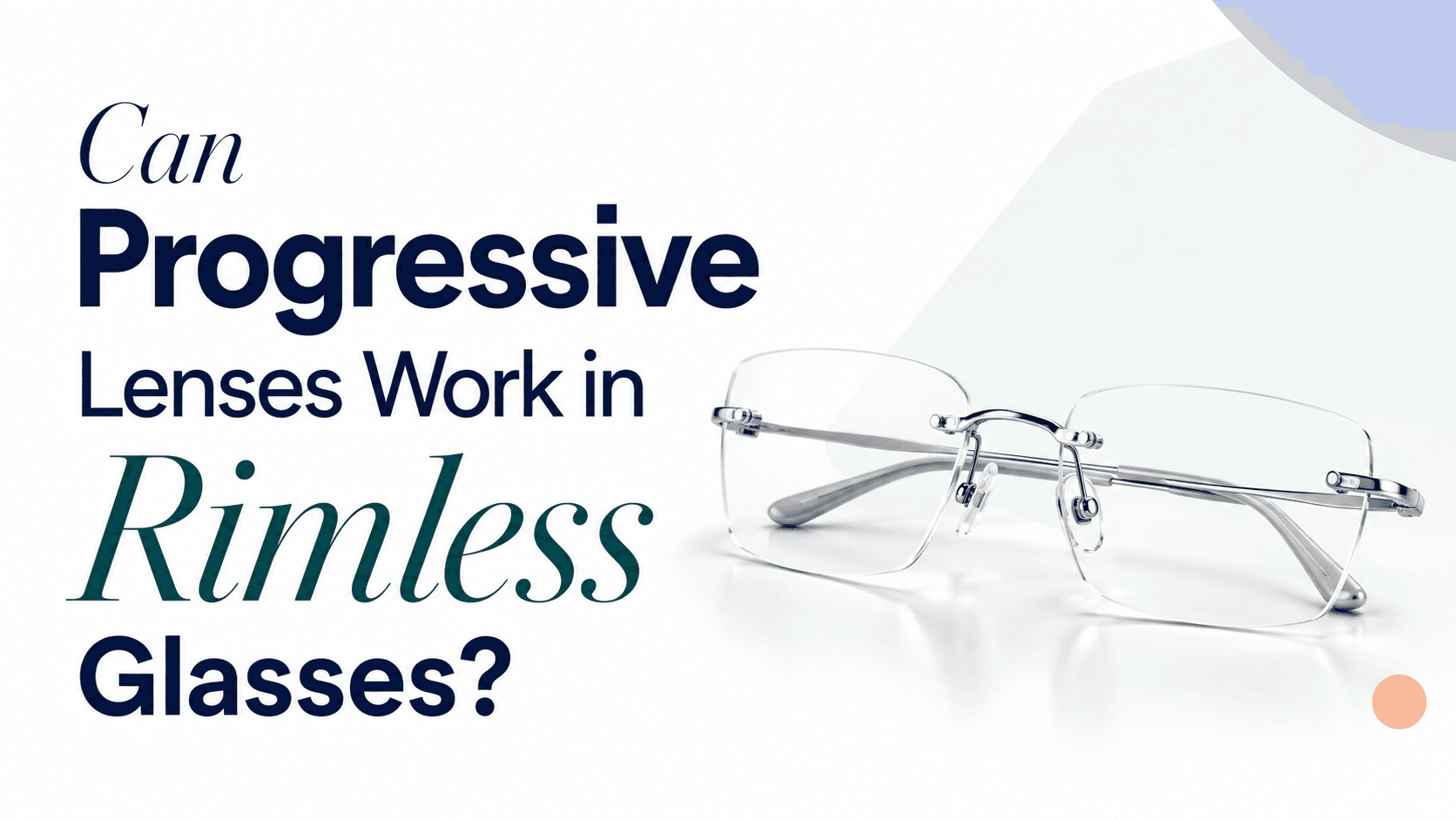
Yes, progressive lenses can work in rimless glasses, but with important caveats. Because rimless frames hold the lens entirely by drill-mounted screws at the bridge and temples, the lens itself bears more structural stress than in full-rim or semi-rimless frames. This means material choice, lens thickness, and corridor length all matter far more than they do with framed options.
Why Rimless Frames Demand Extra Attention with Progressive Lenses
In a full-rim frame, the entire edge of the lens is cradled and protected. In a rimless design, two or three small drill holes carry all the mechanical load. Progressive lenses — especially those with a short fitting height — are already precision-cut pieces of optics. Add drill mounting, and any lens that is too thin at the edges or too brittle can chip, crack, or loosen over time.
The key risk areas are:
Drill-hole stress: Polycarbonate and 1.67 high-index lenses handle drilling better than standard CR-39 plastic, which can micro-crack around mounting points.
Lens size: Rimless frames tend to use smaller, more geometric lens shapes. A progressive lens needs a minimum fitting height — typically 18–22 mm — to fit all three vision zones comfortably. Very small rimless lenses may simply not offer enough vertical space.
Edge thickness: Higher prescriptions produce thicker edges, which can look bulky without a rim to conceal them and can also weaken the drill site.
Which Lens Materials Work Best in Rimless Progressives?
Material selection is the single most important decision when combining progressive lenses with rimless frames.
Polycarbonate (1.59 index): Impact-resistant and holds drill holes well. Slightly lower optical clarity than other materials but the safest structural choice for rimless wear.
1.67 high-index: Thinner and lighter than polycarbonate, suitable for moderate-to-high prescriptions. Drills cleanly when done by an experienced optician.
Trivex: Combines the impact resistance of polycarbonate with better optical clarity. An excellent but sometimes pricier option for rimless progressives.
CR-39 (standard plastic): Generally not recommended for rimless progressive combinations due to lower impact resistance and greater risk of cracking at drill sites.
Progressive Lenses in Rimless vs. Full-Rim Frames: How to Choose
If your primary concern is aesthetics and you love the near-invisible look of rimless glasses, progressives can absolutely be fitted — provided your prescription is in the moderate range (roughly +/- 4.00 D or lower) and your optician confirms the lens height is adequate. For stronger prescriptions, a thin full-rim or semi-rimless frame may actually serve you better: the rim conceals edge thickness and reduces drill-point stress.
What to Ask Your Optician Before Ordering
Before committing to a rimless progressive pair, run through these checks with your eye-care professional:
Is the vertical fitting height of the chosen frame at least 18 mm?
Does my prescription fall within a range where high-index or polycarbonate lenses stay thin enough at the drill sites?
Is an anti-reflective coating included? (It is almost non-negotiable for progressives in any frame, and especially important in rimless where there is no frame edge to reduce glare.)
Will the lab performing the drilling have experience with progressive lens mounting specifically?
The Bottom Line
Rimless glasses with progressive lenses are a stylish, lightweight option that many wearers use successfully every day. The combination works best with polycarbonate or high-index lenses, a moderate prescription, and a frame with enough vertical lens height. Choose a reputable optician who understands the structural demands of drill-mounted progressives, and you'll get the best of both worlds — sharp vision across all distances in a barely-there frame.
