
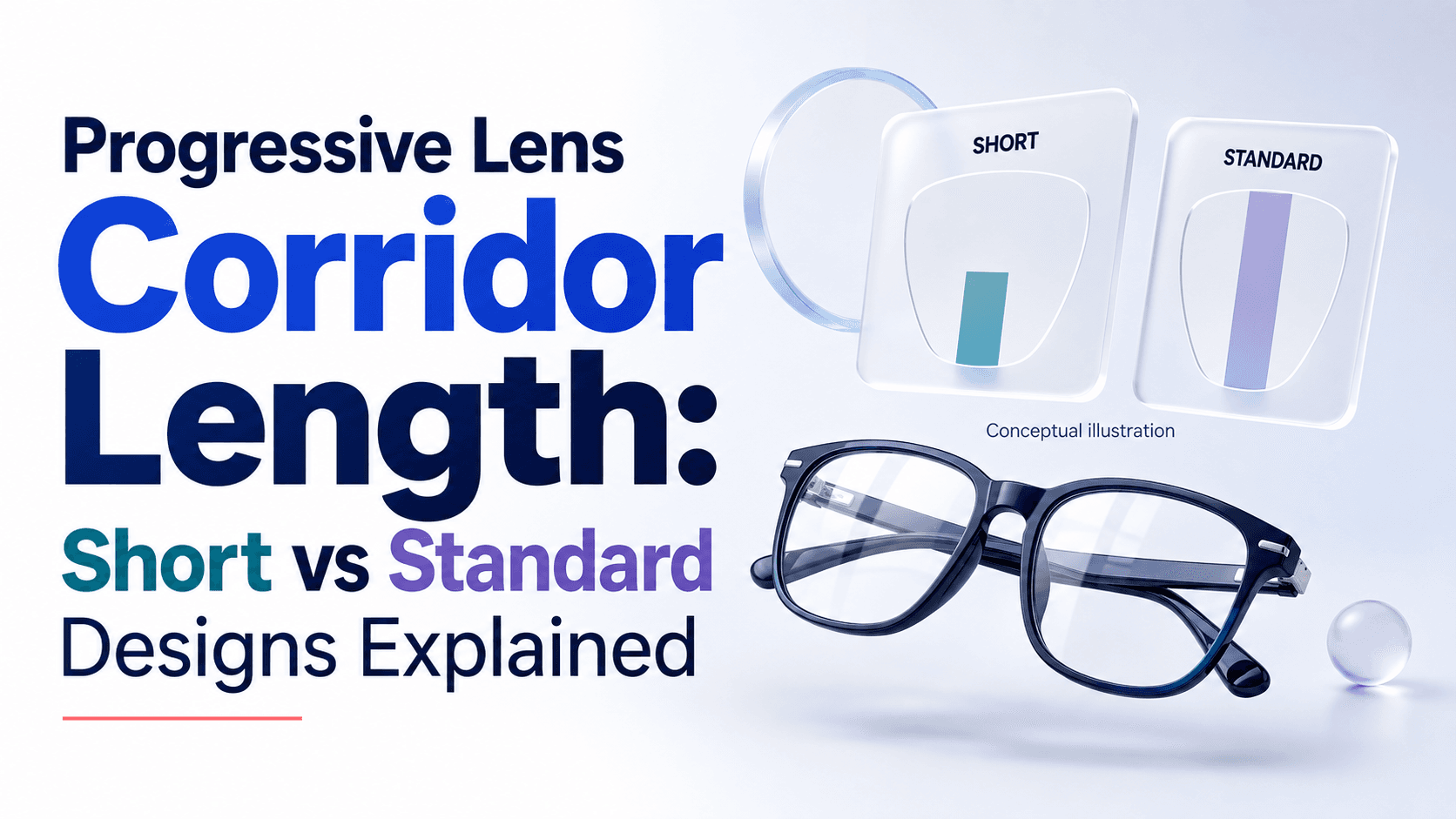
The corridor length of a progressive lens — the narrow channel through which your vision transitions from distance to near — directly determines how comfortable and usable the lens feels. Short corridors (typically 11–14 mm) suit smaller, modern frames, while standard corridors (15–18 mm) offer a wider, more gradual transition zone and are easier to adapt to. Choosing correctly depends on your frame size, prescription strength, and lifestyle.
What Is a Progressive Lens Corridor?
A progressive lens has three optical zones: the distance zone at the top, the intermediate zone in the middle, and the near zone at the bottom. The corridor is the usable channel connecting these zones. Its length is measured vertically in millimetres. Outside this corridor sit the peripheral zones, which cause the characteristic blur or swim effect that new progressive wearers notice.
Short Corridor vs Standard Corridor: Key Differences
Understanding the practical trade-offs helps you match the lens design to your daily needs.
Short corridor (11–14 mm): Designed to fit frames with a smaller fitting height (as low as 26–28 mm). The transition happens over a shorter vertical distance, which means narrower reading and intermediate zones and more peripheral distortion. Best for fashion-forward, compact frames.
Standard corridor (15–18 mm): Requires a larger fitting height (typically 30 mm or more). The gradual transition creates wider, more comfortable reading and intermediate zones with less swim effect. Easier to adapt to, especially for first-time progressive wearers.
Which Design Is Easier to Adapt To?
Standard corridor lenses are almost always easier to adapt to. Because the power changes more gradually, the brain adjusts faster and peripheral distortion is reduced. Optometrists typically recommend standard designs to first-time progressive users or anyone with a strong prescription. Short corridor lenses demand more precise head movement to find the correct zone, which can feel tiring during the adaptation period.
When Should You Choose a Short Corridor?
A short corridor makes sense when your chosen frame simply does not have enough vertical height for a standard design. Many popular rimless, semi-rimless, and cat-eye frames fall into this category. If your heart is set on a compact or fashion-forward frame, a high-quality short-corridor progressive — often called a small-frame progressive — from a premium lens brand is your best option. Just be prepared for a slightly longer adaptation period.
How Frame Fitting Height Affects Your Choice
The single most important measurement is the minimum fitting height stated by the lens manufacturer. Ask your optician to measure the vertical distance from the pupil centre to the bottom of the frame (called the fitting height). If this number is below 28 mm, a short corridor is your only option. Between 28 and 30 mm, either design may work. Above 30 mm, a standard corridor is almost always preferable.
Prescription Strength and Corridor Length
Higher prescriptions — particularly those with significant addition power for reading (above +2.00 Add) — benefit most from standard corridor lenses. The wider near zone reduces eye strain during prolonged reading or screen use. If you spend several hours a day on a laptop or phone, a standard corridor paired with an appropriate frame is a worthwhile investment for long-term eye health.
Tips for a Smooth Transition
Wear your new progressive glasses full-time for the first week rather than switching back to single-vision lenses.
Move your head rather than just your eyes to find the correct zone for each task.
Have your optician verify the fitting height and optical centre before the lens is cut.
Choose frames with a fitting height of at least 30 mm if you are a first-time progressive wearer.
Allow up to two weeks for full adaptation before concluding the design does not suit you.
