
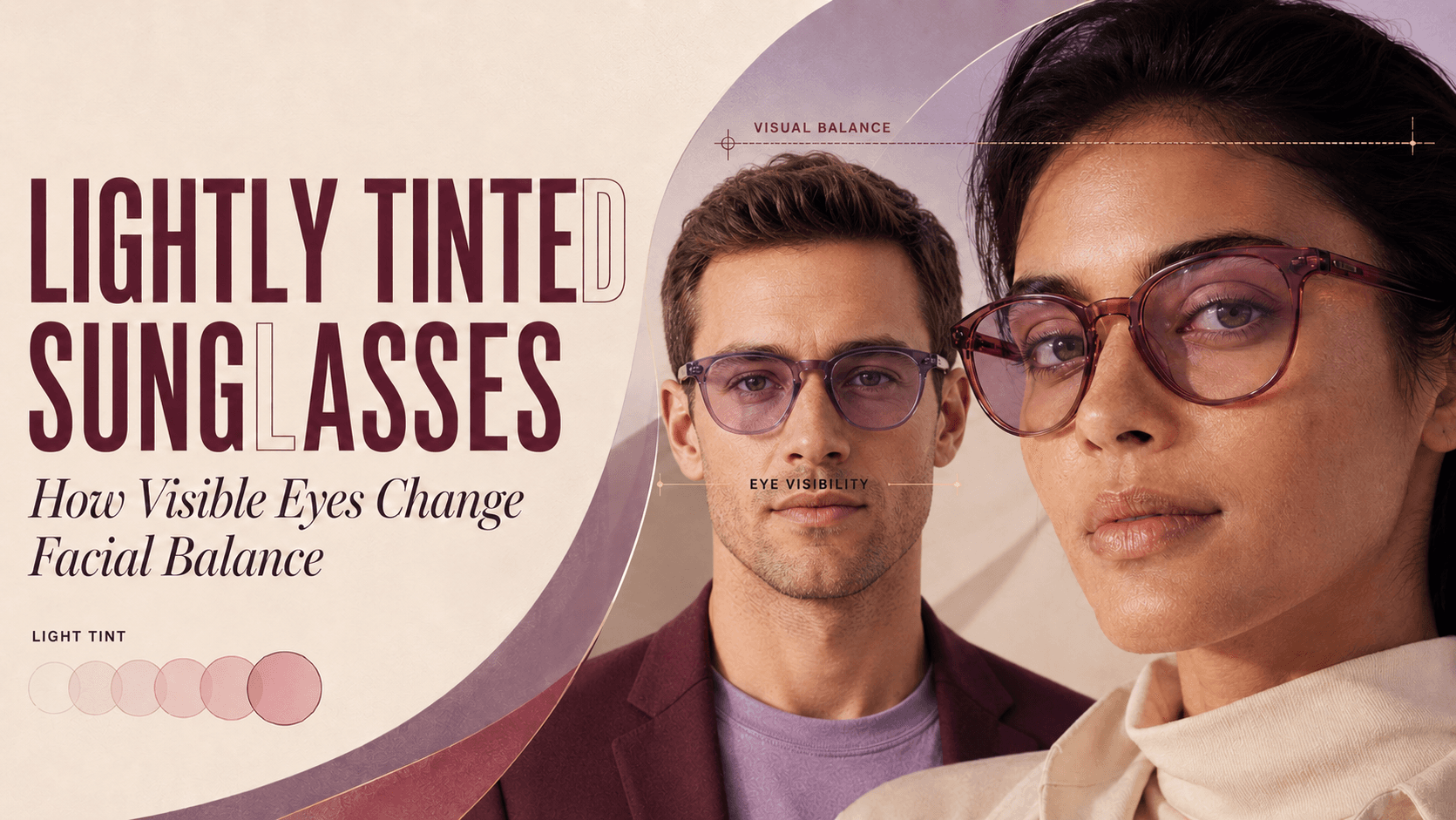
Lightly tinted sunglasses — those with a transmission level of roughly 40–80% — let your eyes remain partially visible through the lens. That single design choice quietly reorganises the visual weight of your face, making features feel more balanced, open, or defined depending on your face shape and frame choice. Unlike dark lenses that create a solid block of colour across the eye zone, a light tint preserves the face's natural focal points while still adding polish and a hint of sun protection.
Why Eye Visibility Matters for Facial Proportion
The eyes sit near the upper-middle third of the face and act as its primary anchor. When dark lenses hide them completely, the lower face — nose, mouth, jaw — takes on disproportionate visual weight. A light tint keeps the eyes in play, so the face reads as a balanced whole rather than a masked upper half sitting above an exposed lower half. This is especially relevant for people with a longer face shape, where maintaining vertical balance is key.
Conversely, on a round face, a very light tint draws the gaze upward and inward, slimming the overall impression without the harshness of an opaque lens blocking all expression. The subtle depth of colour creates definition without erasure.
Light Tint vs Dark Tint: Which Changes Your Look More?
Dark tints command attention through contrast — the block of colour becomes a design element in itself. Light tints work more quietly. They add a veil of colour (rose, grey, amber, green) that shifts the perceived skin tone and eye area without dominating. The result is that you remain the focal point, not the glasses. For everyday wear, editorial styling, or office-friendly looks, this restraint is often more flattering and more versatile.
How Different Tint Colours Affect the Face
Rose or pink tints warm the skin tone and soften sharp features, creating a youthful, approachable impression.
Grey tints are neutral and colour-accurate, keeping the face looking natural while adding a cool, understated edge.
Amber or brown tints add warmth and depth, complementing olive and deeper skin tones particularly well.
Green tints are low-contrast and easy on the eye, lending a relaxed, nature-forward aesthetic without altering perceived skin colour significantly.
Yellow tints brighten the eye area and can make the face appear more alert and energised — popular in sport-adjacent styles.
Choosing the Right Light Tint for Your Face Shape
Face shape still governs frame choice, and a light tint amplifies whatever the frame already does. An oval or round frame in a pale rose tint softens a square jaw beautifully. A geometric frame in light grey keeps a round face structured. Because the eyes remain visible, the frame's silhouette and the tint colour work together rather than the tint overwhelming everything else. Think of the tint as a filter that fine-tunes, not transforms.
Are Lightly Tinted Lenses Practical for Indian Sun?
Light tints (Category 1–2 lenses) offer minimal to moderate UV filtering — adequate for overcast days, indoor use, or early mornings, but not sufficient for peak afternoon sun. If you want the aesthetic of a light tint with real outdoor protection, look for lenses that carry a UV400 coating alongside the tint. Many modern lenses can be lightly tinted and still block 100% of UVA and UVB rays — the tint density and UV protection are separate specifications.
At Rimloo, prescription and non-prescription lenses can be customised with your preferred tint shade, so you get the facial balance benefit without compromising on eye health.
