
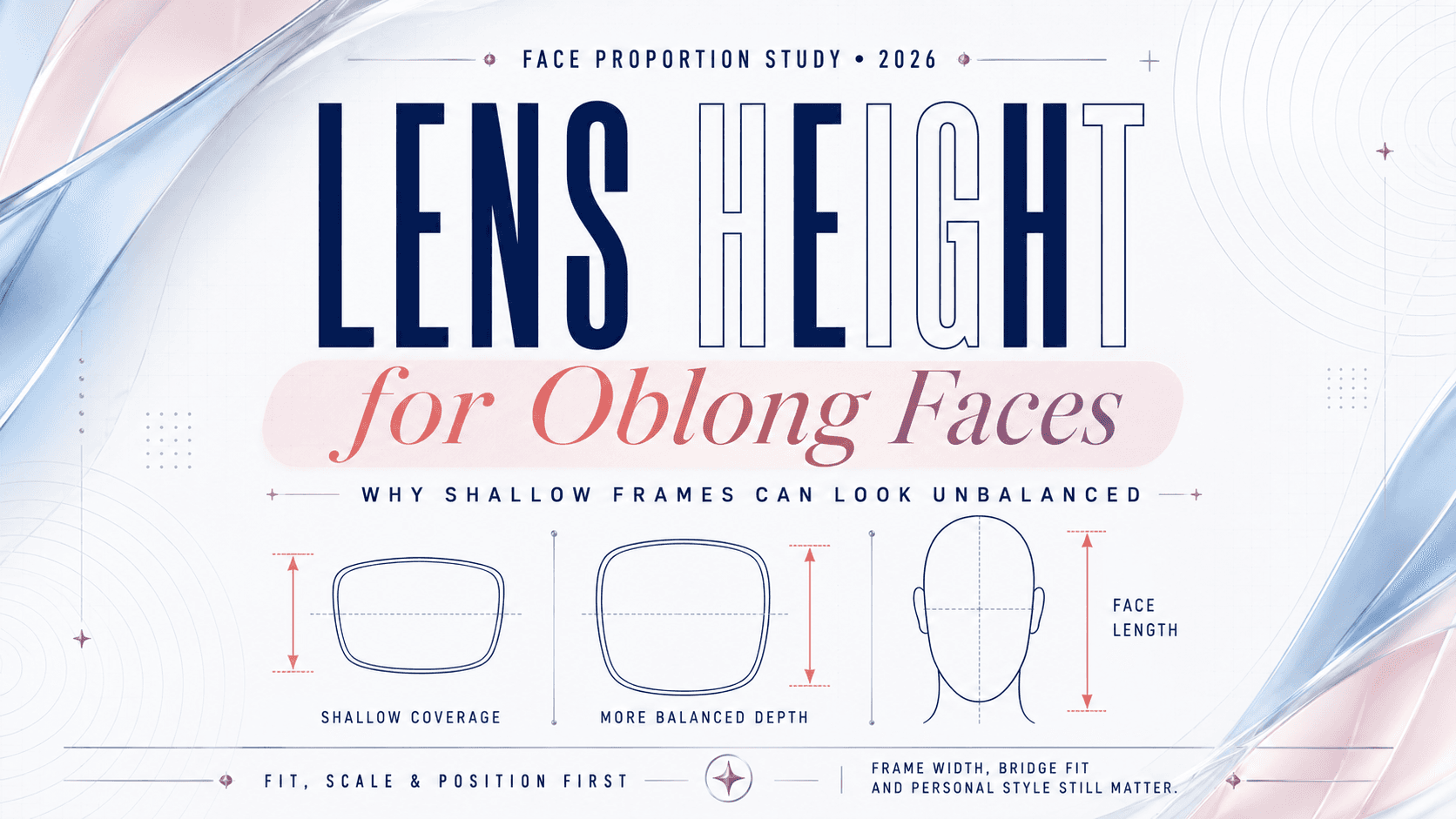
For oblong faces — characterised by a length that noticeably exceeds width — taller lens heights visually widen and shorten the face, creating better proportion. Shallow frames (lens height under 30 mm) tend to emphasise vertical length, making the face appear even longer and the overall look feel off-balance. Choosing frames with a lens height of 36–45 mm is the single most effective fix.
What Makes a Face Oblong?
An oblong face has roughly equal forehead, cheekbone, and jaw widths, but the face is significantly longer than it is wide. Think of it as an oval stretched vertically. Common features include a long, straight cheek line and a gently rounded or squared jawline. This face shape is sometimes confused with oval, but the key difference is that extra length — which frames need to counteract, not reinforce.
Why Shallow Frames Look Off on Oblong Faces
Shallow frames sit on the face as a thin horizontal band. On a shorter face, that band reads as a clean accent. On an oblong face, however, the band leaves large expanses of skin above and below it, drawing the eye up and down the full length of the face. The result is a look that feels elongated and slightly unfinished — even when the frame width is perfectly matched.
The optical illusion works both ways: taller lenses interrupt vertical space, pulling attention sideways and giving the impression of a broader, more balanced face. This is the same principle that makes round and oversized square frames perennial favourites for oblong face shapes.
Ideal Lens Height Range for Oblong Faces
A lens height between 36 mm and 45 mm hits the sweet spot for most oblong faces. Below 32 mm starts to look shallow; above 48 mm can tip into oversized territory unless the frame width is also generous. Measure your current frames from the top of the lens rim to the bottom — that single number tells you more about balance than any other frame dimension.
Frame Shapes That Work Best
The lens height principle pairs naturally with certain frame geometries:
Round frames — equal height and width by definition; inherently tall relative to their footprint
Square frames — strong horizontal top bar plus meaningful vertical depth adds structure
Browline and semi-rimless designs — the thick upper rim draws the eye across, while a medium lens height adds depth
Oversized cat-eye — the upswept outer edge and generous lens area both widen and shorten visually
Shallow Frames vs Taller Frames: A Quick Comparison
Shallow frames (under 32 mm): sleek, minimalist, good for shorter or rounder faces, but risk elongating an already long face shape.
Taller frames (36–45 mm): visually compress vertical length, add perceived width, and create a more proportionate look for oblong faces. They also offer more room for progressive or bifocal prescriptions, which is a practical bonus.
How to Check Lens Height Before You Buy
When shopping online, look for the frame measurements listed in the product details — typically written as lens width × bridge width × temple length. Lens height is often listed separately or visible in the spec table. If it isn't shown, contact the retailer before ordering. A virtual try-on tool can also give you a quick visual sense of whether a frame's proportions suit your face, though nothing beats checking the millimetre specs directly.
Getting lens height right is a small detail with a large visual payoff — especially for oblong faces where every millimetre of vertical space is working for or against you.
