
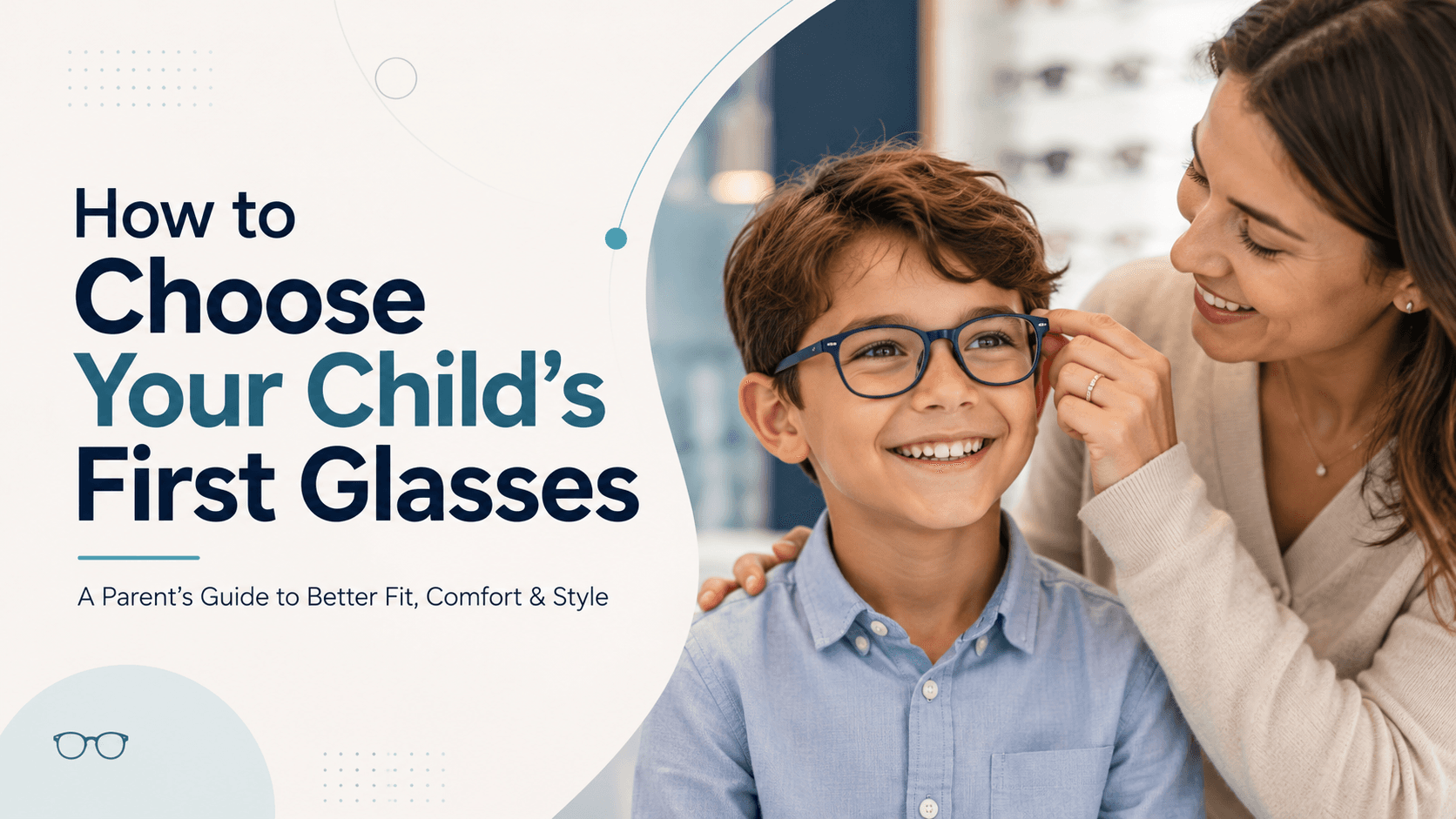
Your child’s first pair of glasses can bring up several emotions at once.
You may feel relieved that their vision problem has finally been identified. You may worry about whether the glasses will fit properly, survive school life or stay on your child’s face for more than a few minutes. Your child may feel excited about choosing a new frame—or nervous about looking different in front of friends.
All of these reactions are normal.
The goal is not simply to buy a frame that looks good. Your child needs glasses that match their prescription, sit comfortably, support clear vision and feel natural enough to wear every day.
This guide explains how to choose your child’s first glasses with greater confidence, from recognising possible vision problems to selecting safe lenses, checking the frame fit and helping your child adjust emotionally.
How Do I Know Whether My Child Needs Glasses?
Some children clearly say that the classroom board looks blurry. Others may not realise that their vision is different because they have never experienced anything else.
Possible signs of a vision problem include:
Squinting while watching television or looking at distant objects
Sitting unusually close to a screen
Holding books, tablets or homework very close
Frequently rubbing the eyes
Complaining of headaches or tired eyes
Tilting the head or covering one eye
Losing their place while reading
Avoiding reading, drawing or other close-up activities
Difficulty seeing the classroom board
A noticeable change in classroom participation
These behaviours do not automatically mean that your child needs glasses. Headaches, eye rubbing and reading difficulties can have several causes. However, they are good reasons to arrange an examination with a qualified optometrist or ophthalmologist experienced in children’s eye care.
You can also read Rimloo’s guide to why children squint while reading or watching television.
Seek prompt medical attention if your child develops sudden vision loss, severe eye pain, an eye injury, a newly misaligned eye or an unusual white or grey appearance in the pupil.
Start With a Proper Eye Examination
Do not guess your child’s prescription or order lenses using an old prescription.
A child’s prescription may contain values for nearsightedness, farsightedness or astigmatism. Some children may also require treatment for conditions such as amblyopia or strabismus. In these situations, wearing glasses exactly as prescribed can be an important part of healthy visual development.
Before ordering, confirm:
The prescription is current.
The right-eye and left-eye values are entered correctly.
Plus and minus signs have not been changed.
Cylinder and axis values are included when prescribed.
The pupillary distance and fitting measurements are appropriate for the child.
Rimloo’s guide to reading an eyeglass prescription explains common prescription terms. For a child’s first pair, however, it is safer to have pupillary distance and fitting height measured by an eye-care professional or trained optical dispenser rather than relying only on a home measurement.
What Frame Material Is Best for Children?
Children need frames that can handle school bags, playground movement, accidental drops and everyday handling. No frame is completely unbreakable, but some materials are better suited to active children.
Flexible nylon or TR-90
TR-90 frames are lightweight and flexible. They can be a practical option for younger or highly active children because they are more resistant to everyday bending than many rigid frames.
Flexibility does not mean the frame cannot be damaged, so the hinges, bridge and overall construction should still be checked carefully.
Acetate
Acetate frames are available in a wide variety of colours and patterns. They can feel stable and substantial, although some designs are heavier than flexible nylon frames.
Choose lightweight acetate with smooth edges and a bridge that fits the child securely.
Stainless steel or titanium
Metal frames can be thin, lightweight and adjustable. Titanium is especially light and corrosion resistant, although it may cost more.
Metal frames may work well for older children who handle their glasses carefully. Check that the nose pads and temple ends are secure and comfortable.
Silicone or soft rubber frames
Soft, flexible frames are often suitable for babies, toddlers and very young children. Some designs use a head strap or wraparound temple system to keep the glasses in place.
The best material ultimately depends on your child’s age, prescription, activity level, sensitivity and facial measurements.
How Should Children’s Glasses Fit?
Even a beautiful frame will remain in its case if it slides, pinches or hurts.
Children’s faces are still developing, so adult fitting rules cannot simply be applied to a smaller frame. A trained optical professional should check the frame after the lenses have been fitted.
Use this practical checklist:
1. The frame stays level
The glasses should not lean noticeably to one side. Both lenses should sit at approximately the same height.
2. The bridge feels secure
The frame should rest comfortably on the nose without leaving deep pressure marks or repeatedly sliding downward.
Children with a lower or flatter nose bridge may benefit from a low-bridge design, saddle bridge or appropriately positioned nose pads.
3. The eyes are well positioned within the lenses
The child’s eyes should appear reasonably centred within the lens area. The exact optical-centre and fitting measurements should be determined from the prescription and professional measurements.
4. The temples are comfortable
The arms should travel naturally along the sides of the head. They should not flare dramatically outward, squeeze the temples or press painfully behind the ears.
5. The frame does not rest on the cheeks
Ask your child to smile. The lower edge of the frame should not rise significantly or press into the cheeks.
6. The eyelashes do not touch the lenses
Lashes brushing against the lenses can become irritating and leave frequent marks.
7. The glasses remain stable during movement
Ask your child to look down, turn their head gently and walk around. The glasses should remain in position without needing constant adjustment.
Learn more about lens width, bridge width and temple length in Rimloo’s frame-size measurement guide.
Which Lens Features Are Worth Considering?
Parents are often presented with several coatings and upgrades. Not all of them are equally important.
Impact resistance: high priority
For everyday children’s eyewear, impact-resistant lens material should be one of the first considerations.
Remember that ordinary prescription glasses are not a replacement for certified protective sports eyewear. Children playing sports with a risk of impact should use properly fitted sports goggles recommended for that activity.
UV protection: high priority
Children spend considerable time outdoors, so their eyewear should provide appropriate ultraviolet protection.
Polycarbonate lenses generally include UV protection. For sunglasses, look for lenses labelled as blocking 99% to 100% of UVA and UVB radiation.
Scratch-resistant treatment: practical
This treatment is useful because children may place their glasses on desks, carry them in bags or clean them incorrectly.
Anti-reflective coating: optional but useful
An anti-reflective coating reduces visible reflections from the front and back surfaces of the lenses. It may improve lens clarity and make the child’s eyes more visible in photographs.
The coating should be paired with proper cleaning habits because damaged or heavily scratched coatings can become distracting.
Blue-light filtering: optional, not essential
Blue-light filtering should not be presented as a medical necessity for school children.
Current evidence does not show that blue light from ordinary digital screens damages children’s eyes, and the American Academy of Ophthalmology does not recommend special blue-light eyewear solely for computer use.
For screen comfort, focus first on:
Using the correct prescription
Reducing glare
Keeping screens at a comfortable distance
Adjusting brightness to suit the room
Encouraging regular blinking
Taking frequent visual breaks
Limiting screens close to bedtime
Balancing indoor activity with outdoor time
A blue-light filter may still be selected as a personal preference after discussing it with the child’s eye-care professional, but it should not replace these habits.
How Can I Help My Child Feel Comfortable Wearing Glasses?
For many parents, choosing the frame is easier than persuading the child to wear it.
A child may worry about teasing, photographs, sports or simply seeing a different face in the mirror. Responding with patience usually works better than turning the glasses into a daily argument.
Let your child participate
Allow your child to choose between two or three parent-approved frames that fit properly.
Even a small choice—such as deciding between blue, black or transparent—can give the child a sense of ownership.
Focus on comfort before appearance
Ask specific questions:
Does the bridge hurt?
Do the arms feel tight?
Do the glasses slip when you look down?
Can you see clearly?
Do your eyelashes touch the lenses?
A child who repeatedly removes their glasses may be uncomfortable rather than disobedient.
Use positive, natural language
Avoid saying that your child “has bad eyes” or “must wear glasses because something is wrong.”
Try language such as:
“Your glasses help your eyes see the board clearly.”
“This colour really suits you.”
“Let’s make sure they feel comfortable.”
Introduce the glasses at home
Let your child wear the glasses around familiar people before their first full school day. This gives them time to become comfortable with the frame and their reflection.
Involve the teacher
Tell the teacher when the child is starting a new prescription. The teacher can help encourage consistent wear, notice slipping frames and report continued difficulty seeing the board without drawing unnecessary attention.
Praise the behaviour, not only the appearance
Specific encouragement is more useful than repeated comments about looking cute.
For example:
“You remembered to put your glasses in the case.”
“You wore them throughout your reading time.”
“You told me when the frame felt loose—that was helpful.”
For more confidence-building ideas, read how to help a child feel comfortable wearing glasses at school.
How Often Should the Prescription and Frame Be Checked?
Follow the schedule recommended by your child’s optometrist or ophthalmologist.
Many children with myopia are reviewed approximately once a year, but appointments may be more frequent when:
The prescription is changing quickly
The child is receiving myopia-control treatment
Amblyopia or strabismus is being monitored
The child reports new headaches or blur
School performance or visual behaviour changes
The glasses no longer appear to help
Frame fit should also be checked whenever the glasses begin slipping, tilting, pinching or sitting too close to the eyes.
Because children grow quickly, a frame that fitted well several months ago may no longer align correctly. Professional adjustments are often simple and can prevent the child from abandoning an otherwise suitable pair.
How to Care for Children’s Glasses
Teach a simple routine from the first day.
Store the glasses in a hard case when they are not being worn.
Use both hands when putting them on or taking them off.
Rinse away dust before wiping when possible.
Clean the lenses with a clean microfibre cloth and lens-safe solution.
Do not use paper towels, tissues or clothing to clean the lenses.
Never place the glasses lens-side down.
Keep them away from high heat, including hot car dashboards.
Check periodically for loose screws, bent temples and damaged nose pads.
Visit an optical professional rather than trying to make major frame adjustments at home.
Writing the child’s name and a parent’s phone number inside the case can also help lost glasses find their way home.
Final Checklist for Buying Your Child’s First Glasses
Before placing an order, confirm that:
You have a current prescription.
The prescription values have been entered accurately.
Pupillary distance and fitting measurements have been checked.
The frame matches your child’s face width and bridge.
The frame remains stable without pinching.
The lens material is appropriate for a child.
UV and impact protection have been considered.
Your child feels comfortable with the colour and style.
You understand how and when the glasses should be worn.
You know when the next professional review is due.
Once these essentials are confirmed, you can explore prescription eyeglasses at Rimloo and compare frames by size, shape, material and everyday comfort.
A Clearer View—and a More Confident Start
Your child’s first glasses are not just another purchase. They become part of school mornings, homework, playtime, family photographs and the way your child experiences the world.
Choose safety and fit first. Involve your child in the style decision. Listen when something feels uncomfortable, and stay in touch with their eye-care professional as their vision and face grow.
A well-fitted pair that your child feels proud to wear is far more valuable than a fashionable frame that spends every day inside its case.
Medical disclaimer: This article provides general educational information and is not a substitute for an examination, diagnosis or personalised recommendation from a qualified optometrist or ophthalmologist.
