
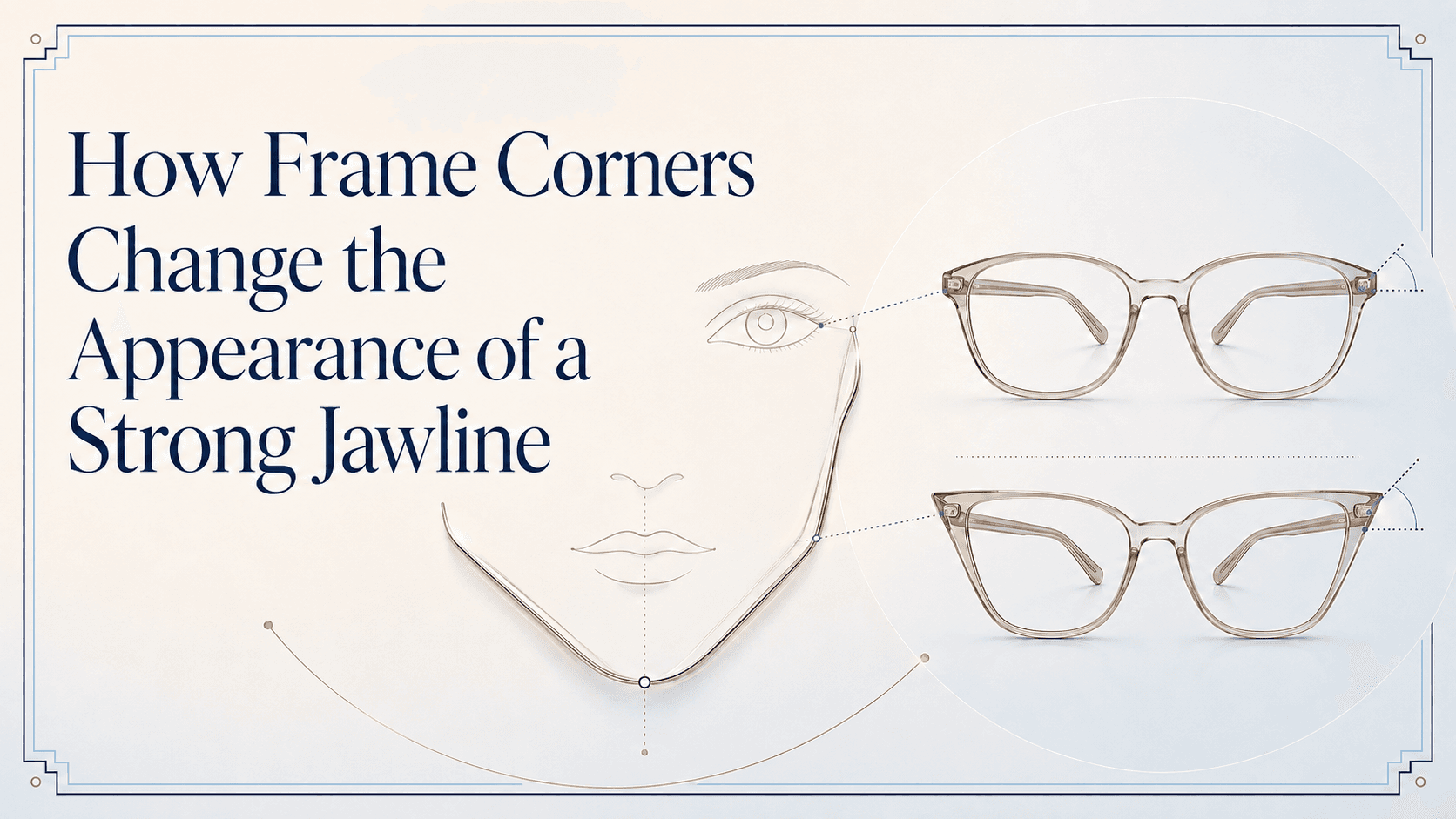
The corners of your eyeglass frames are one of the most underrated styling tools you own. If you have a strong, defined jawline — common in square, rectangle, and oblong face shapes — the geometry of your frames can either amplify that sharpness or bring the whole face into a softer, more balanced harmony. Choosing the right frame corners is less about hiding features and more about controlling visual emphasis.
Why Frame Corners Matter for a Defined Jaw
Your eye naturally travels across a face in a Z-pattern, moving from the forehead down through the eyes and across to the jaw. Frames sit right at the visual midpoint of this journey. When frame corners echo the angularity of a strong jaw — think sharp rectangular or geometric frames — that sharpness is reinforced throughout the face. When frame corners contrast with the jaw — rounded or oval shapes — the eye is drawn upward and the jaw appears less dominant. This is the fundamental principle behind frame-corner styling.
Rounded Corners: Softening Without Losing Structure
Oval and round frames, or rectangular frames with noticeably curved corners, introduce a counterpoint to a squared-off jaw. The soft curve at the corner of the frame pulls visual attention to the upper third of your face — your eyes and brows — and lets the jaw recede naturally. This is an excellent choice if you want a more approachable, relaxed aesthetic without looking like you are trying too hard to conceal anything.
Rimless and semi-rimless styles with subtle corner curves also work here. Because they add minimal visual weight, they prevent the face from feeling top-heavy while still softening the overall silhouette.
Angular Corners: Leaning Into the Jawline
Sharp-cornered frames — classic wayfarers, bold rectangles, or strong geometric hexagons — double down on a defined jaw and create a look of deliberate confidence. This pairing works particularly well in professional or editorial contexts where a strong, structured face is an asset. The key is to keep the frame proportional: an oversized sharp frame on an already angular face can tip from confident into overwhelming.
The In-Between Option: Soft-Square and Browline Frames
Soft-square frames — rectangles with gently clipped corners — offer the best of both worlds for a strong jawline. They provide enough structure to look intentional and modern while the slight curve at the corners prevents the face from reading as too severe. Browline frames, which carry visual weight at the top of the lens, are another smart pick: they shift emphasis upward and away from the jaw while still projecting a bold, put-together style.
Proportions and Lens Width: The Detail Most People Miss
Corner shape is only half the equation. A frame that is too narrow makes a wide jaw look wider by comparison; a frame whose width roughly matches your cheekbone-to-cheekbone measurement keeps everything in proportion. When evaluating any frame, check both the corner style and the total lens width before deciding.
Quick Guide: Corner Style vs. Jawline Goal
Rounded corners — soften and balance a strong jaw, add warmth to the face
Sharp angular corners — emphasise structure, project authority and boldness
Soft-square corners — balanced choice, modern and versatile for most occasions
Browline frames — redirect focus upward, flatter almost any strong-jaw face shape
Rimless/semi-rimless — minimal interference, best when you want the jaw to speak for itself
Understanding how frame corners interact with your jawline gives you a precise styling lever that most people overlook. Whether you want to soften, balance, or own your strong jaw, the right corner geometry makes the difference.
