
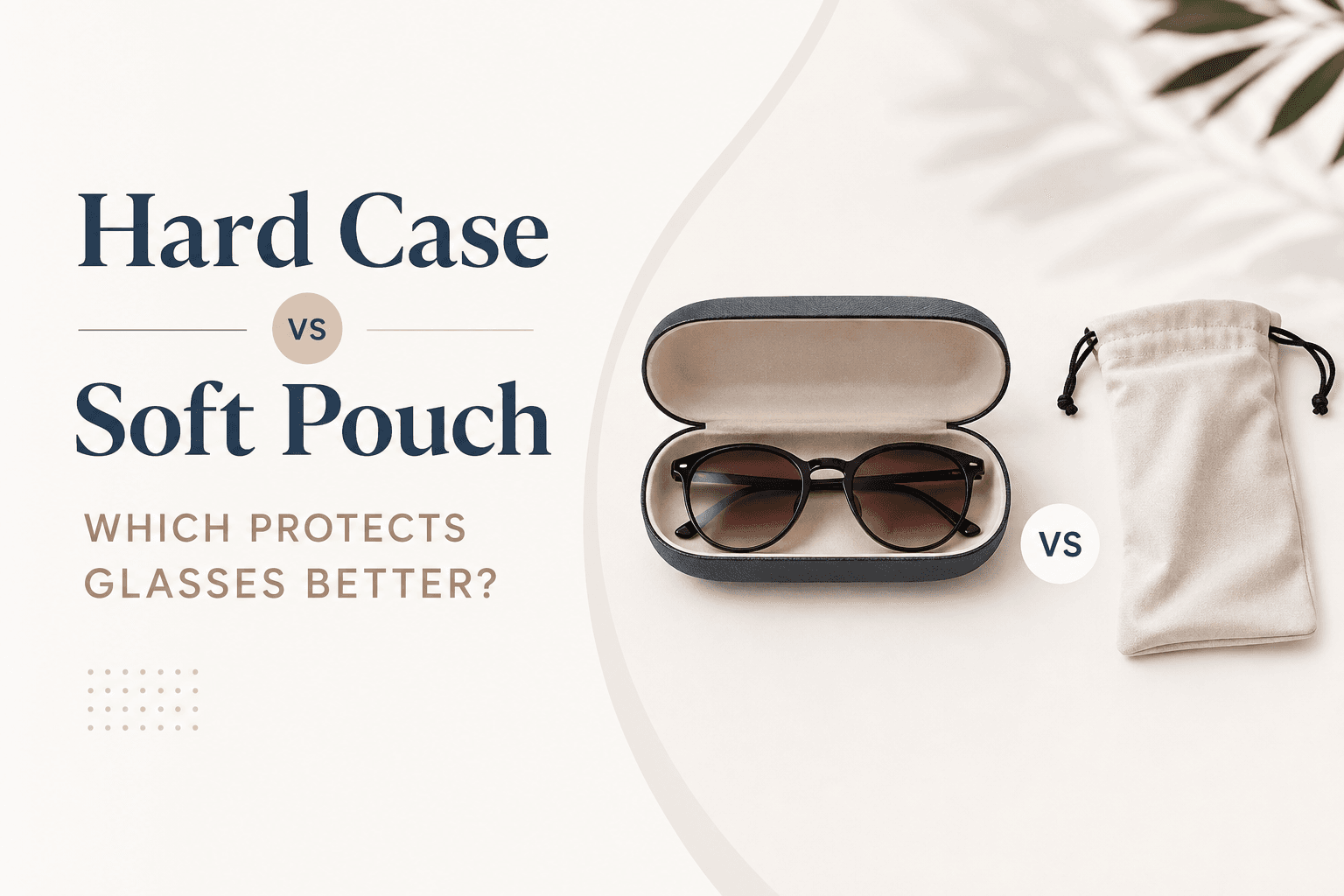
A hard case protects glasses significantly better than a soft pouch in most situations. Hard cases absorb impact, resist crushing, and block dust and debris, making them the right choice for daily carry and travel. Soft pouches, while lightweight and scratch-friendly for short-term use, offer almost no structural protection against pressure or drops.
What Does a Hard Eyeglass Case Actually Do?
A hard case — typically made from polycarbonate, ABS plastic, or metal — creates a rigid shell around your glasses. If your bag gets compressed at the bottom of an overhead bin or under a pile of books, the case holds its shape and your frames stay intact. The interior lining, usually microfibre or velvet, prevents the lenses from picking up scratches while the glasses sit inside.
Hard cases are especially important for rimless and semi-rimless frames, which are structurally delicate. A slight squeeze in a soft pouch can snap a rimless drill-mount lens. For full-rim acetate or metal frames, a hard case still extends frame life by preventing the temples from bending out of alignment over time.
When Does a Soft Pouch Make Sense?
Soft pouches — usually microfibre or neoprene — serve a specific, limited purpose: wiping and very short-term storage. If you are switching between sunglasses and prescription glasses during the day and keeping both close to hand in a jacket pocket, a pouch keeps the lenses from rubbing against your phone or keys. That is its real job.
What a soft pouch cannot do is resist pressure. Sit on a pouch, drop a loaded bag, or pack it at the bottom of a gym bag and the probability of bent frames or scratched lenses rises sharply. Think of the pouch as a lens cloth you can also wrap around your glasses, not as protective storage.
Hard Case vs Soft Pouch: A Direct Comparison
Impact protection: Hard case wins clearly — the rigid shell absorbs shock that would transfer straight to frames in a pouch.
Crush resistance: Hard case only. A soft pouch provides zero resistance to compression.
Scratch prevention: Both are effective when glasses are stationary, but a microfibre-lined hard case is marginally better for long-term storage.
Portability and weight: Soft pouch is the lighter and slimmer option — useful when travel weight matters.
Best for travel: Hard case, without question. Checked luggage and overhead bins are hostile environments.
Best for sunglasses on a day out: A hard case if you have bag space; a pouch only if you will keep the bag close and underpacked.
What About Your Lens Coating?
Anti-reflective, blue-light-blocking, and photochromic coatings are more vulnerable than bare lenses because the coating layer is thin and can micro-crack under repeated stress. Storing coated lenses in a soft pouch that gets compressed regularly shortens the life of the coating noticeably. If your glasses have a premium multi-coat, a hard case is not optional — it is the minimum sensible standard.
The Practical Recommendation
Use a hard case as your primary storage — at home on the nightstand, in your bag, and in your luggage. Keep a soft pouch as a secondary tool for lens cleaning and as a temporary holder when you are actively switching eyewear. Owning both costs very little and eliminates the trade-off entirely.
