
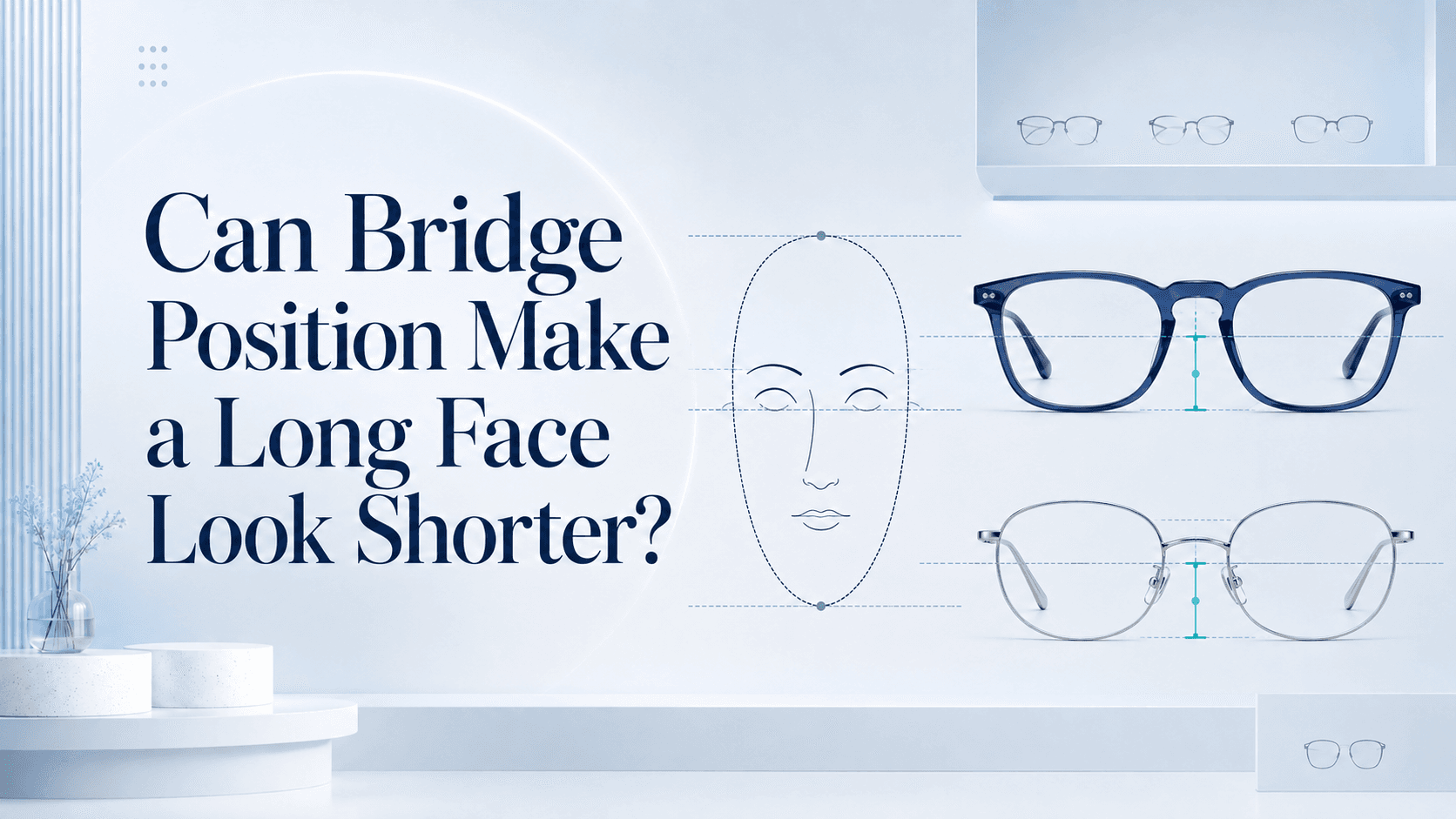
Yes, bridge position can make a long face look shorter. A high-sitting bridge draws the eye upward and adds vertical emphasis, while a low or mid-sitting bridge divides the face more evenly across its width, creating the illusion of a shorter, more balanced face. For people with long or oblong face shapes, choosing frames with a lower bridge position is one of the simplest styling tricks available.
What Is Bridge Position and Why Does It Matter?
The bridge is the part of the frame that rests on your nose, connecting the two lenses. Its vertical placement on the frame determines where your glasses sit on your face — and that placement shifts the visual midpoint of your entire face. When the bridge sits low on the frame, the lenses appear higher on your face, which widens the perceived face width and shortens its apparent length. When the bridge sits high, lenses drop lower, elongating the look.
How a Low Bridge Position Shortens a Long Face
On a long or oblong face, the goal is to add horizontal emphasis and reduce vertical length. A low bridge position achieves this in two ways:
It pushes the optical centre of the lens upward, pulling the viewer's gaze across the width of the face rather than down its length.
It allows wider, deeper lens shapes to sit comfortably without sliding, maximising the horizontal mass of the frame.
Pair a low bridge with wide rectangular or round frames and you double the shortening effect. Avoid narrow, tall lens shapes — they counteract everything the bridge position is doing for you.
High Bridge vs Low Bridge: Which Should a Long Face Choose?
A high bridge lifts the frame high on the nose. This is flattering for round or square faces because it adds length. For a long face, it works against you — avoid it. A low or keyhole bridge lets the frame sit lower and wider, cutting the face visually in half. This is your go-to choice. A saddle bridge (which distributes weight evenly across the nose) often sits at a neutral mid-height and can work well if the lens shape is wide and deep enough.
Frame Styles That Complement a Low Bridge for Long Faces
Bridge position works best when it is paired with the right overall frame design. Look for these features:
Wide frames that extend slightly beyond the widest point of your cheeks
Deep lenses — frames with more vertical height in the lens — to fill more facial real estate
Decorative top bars or bold brow lines that draw attention horizontally
Aviator or round silhouettes, which naturally carry a lower bridge
Avoid rimless or semi-rimless designs, which minimise the visual impact of the frame
Does Nose Pad Adjustment Also Help?
If your frames have adjustable nose pads, a trained optician can lower them slightly to mimic the effect of a low-set bridge. This is a useful tweak if you have already purchased frames and want to refine the fit. However, it is a secondary fix — choosing the right bridge position at the point of purchase will always give a more reliable result.
Understanding bridge position is a small detail with a disproportionately large impact on how your glasses frame your face. If you have a long face, make it one of the first things you check when browsing frames — not an afterthought.
