
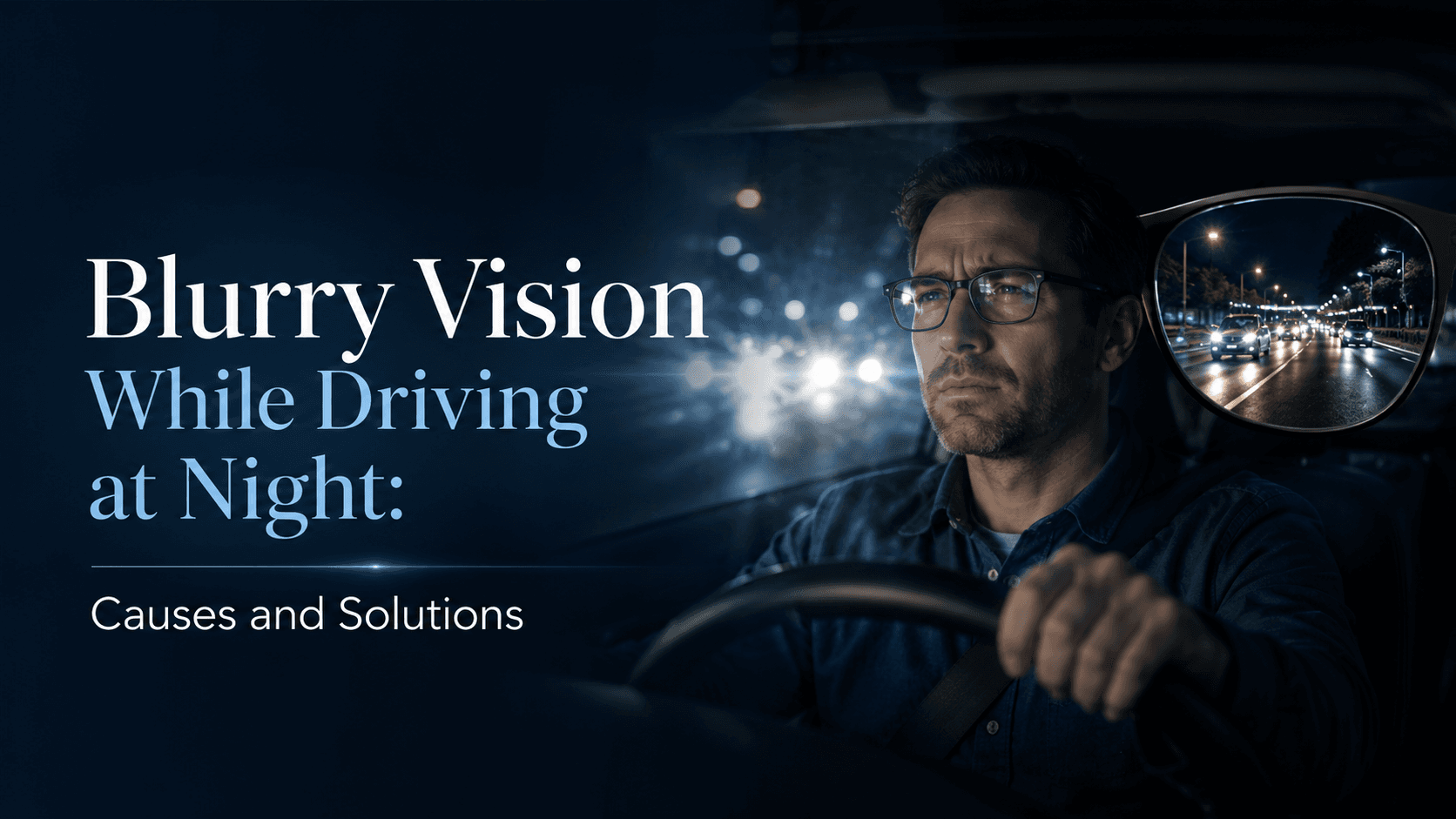
Blurry vision while driving at night is most commonly caused by uncorrected or under-corrected refractive errors — such as myopia or astigmatism — that become more pronounced in low-light conditions when your pupils dilate. Anti-reflective coated lenses, an updated prescription, and avoiding tinted lenses at night are the most effective solutions for the majority of drivers.
Why Does Vision Get Blurry Specifically at Night?
During the day, your pupils are small, which naturally masks minor focusing errors. After sundown, your pupils dilate to let in more light, and this wider aperture exposes the imperfections in your eye's optical system. The result: halos around headlights, streaking of oncoming beams, and a general softness to road signs and lane markings. Even a small uncorrected prescription — one you barely notice during daylight — can become a genuine safety hazard once the sun goes down.
What Are the Most Common Causes?
1. Uncorrected Refractive Errors
Myopia (nearsightedness) and astigmatism are the leading culprits. Astigmatism, in particular, causes light to scatter rather than focus on a single point, producing the starburst and halo effects that drivers often describe around streetlights and headlights. If your current glasses prescription is more than a year old, an outdated correction could be making night driving worse than it needs to be.
2. Night Myopia
Some people have what optometrists call night myopia — a small degree of nearsightedness that only appears in dim light as the eye's lens relaxes. Their daytime vision tests perfectly normal, yet they genuinely struggle after dark. A small additional minus correction in a dedicated night-driving pair of glasses can resolve this entirely.
3. Lens Coatings and Lens Quality
Scratched lenses scatter light aggressively. Lenses without an anti-reflective (AR) coating create internal reflections that superimpose ghost images over oncoming headlights. Budget lenses made from lower-quality optical polymers often have uneven refractive indices that worsen glare. Upgrading to an AR-coated, scratch-free lens is one of the fastest improvements you can make.
4. Cataracts
Early-stage cataracts cloud the eye's natural lens and are a significant cause of night-driving difficulty in people over 40. The clouding scatters incoming light before it reaches the retina, creating intense glare and reduced contrast. If halos and glare have worsened progressively over several months, an eye examination to rule out cataracts is essential.
5. Dry Eyes
The tear film on your cornea acts as the eye's first optical surface. When it is unstable — as it is with chronic dry eye — it introduces micro-aberrations that blur vision intermittently. Drivers often notice this worsens after 30–40 minutes on the road because extended focus and reduced blinking accelerate tear evaporation.
6. Vitamin A Deficiency
Vitamin A is essential for producing rhodopsin, the pigment in your retinal rod cells that enables vision in low light. A deficiency — more common in India than many assume — leads to night blindness (nyctalopia). Unlike the other causes above, this is a nutritional and medical issue that requires dietary correction and physician guidance, not just an updated prescription.
Are Yellow-Tinted "Night Driving" Glasses Actually Helpful?
This is one of the most persistent myths in eyewear. Yellow-tinted lenses reduce overall light transmission, which means your eyes receive less light — the opposite of what you need at night. While they slightly increase perceived contrast in foggy or overcast daytime conditions, multiple peer-reviewed studies have found no benefit for nighttime glare and some evidence of harm by darkening the visual field. Anti-reflective clear lenses outperform yellow-tinted lenses for night driving in every meaningful metric.
Solutions: What You Can Do Right Now
Get an Updated Eye Examination
If you have not had your eyes tested in the last 12 months, start here. Ask your optometrist specifically about night myopia and whether your current prescription includes the best correction for low-light conditions. A small prescription change can make a dramatic difference.
Choose Lenses With a High-Quality AR Coating
Anti-reflective coating eliminates the internal lens reflections that create ghost images and halos. Pair it with a hard multi-coat that resists scratches, because even fine scratches on a coated lens will scatter light badly. When browsing frames at Rimloo, look for lenses that explicitly include an AR coating — it should be non-negotiable for any driving pair.
Treat Underlying Dry Eye
Preservative-free lubricating eye drops used before a long drive can stabilise the tear film enough to noticeably sharpen vision. Consult an ophthalmologist if dryness is persistent; underlying causes such as meibomian gland dysfunction benefit from targeted treatment rather than just drops.
Keep Your Lenses Clean
Smudges, oils, and dust on lens surfaces scatter light in the same way scratches do. Clean your lenses with a microfibre cloth and lens solution before every night drive. Never use a shirt hem or tissue — these leave micro-scratches over time.
Adjust Your Car's Interior Lighting
Bright dashboard displays and cabin lights force your pupils to constrict, reducing your ability to see in the dark outside the vehicle. Dim your instrument cluster to the lowest comfortable level and avoid using your phone screen while driving.
When to See a Doctor Urgently
If night vision has deteriorated rapidly over a few weeks, if you see coloured rings (not just white halos) around lights, or if one eye is significantly worse than the other, visit an ophthalmologist promptly. These patterns can indicate raised intraocular pressure, early glaucoma, or retinal issues that require medical — not optical — intervention.
Night driving is one of the most demanding visual tasks we perform routinely. The good news is that for the majority of people, the fix is straightforward: an accurate, up-to-date prescription combined with quality AR-coated lenses eliminates most of the problem entirely.
