
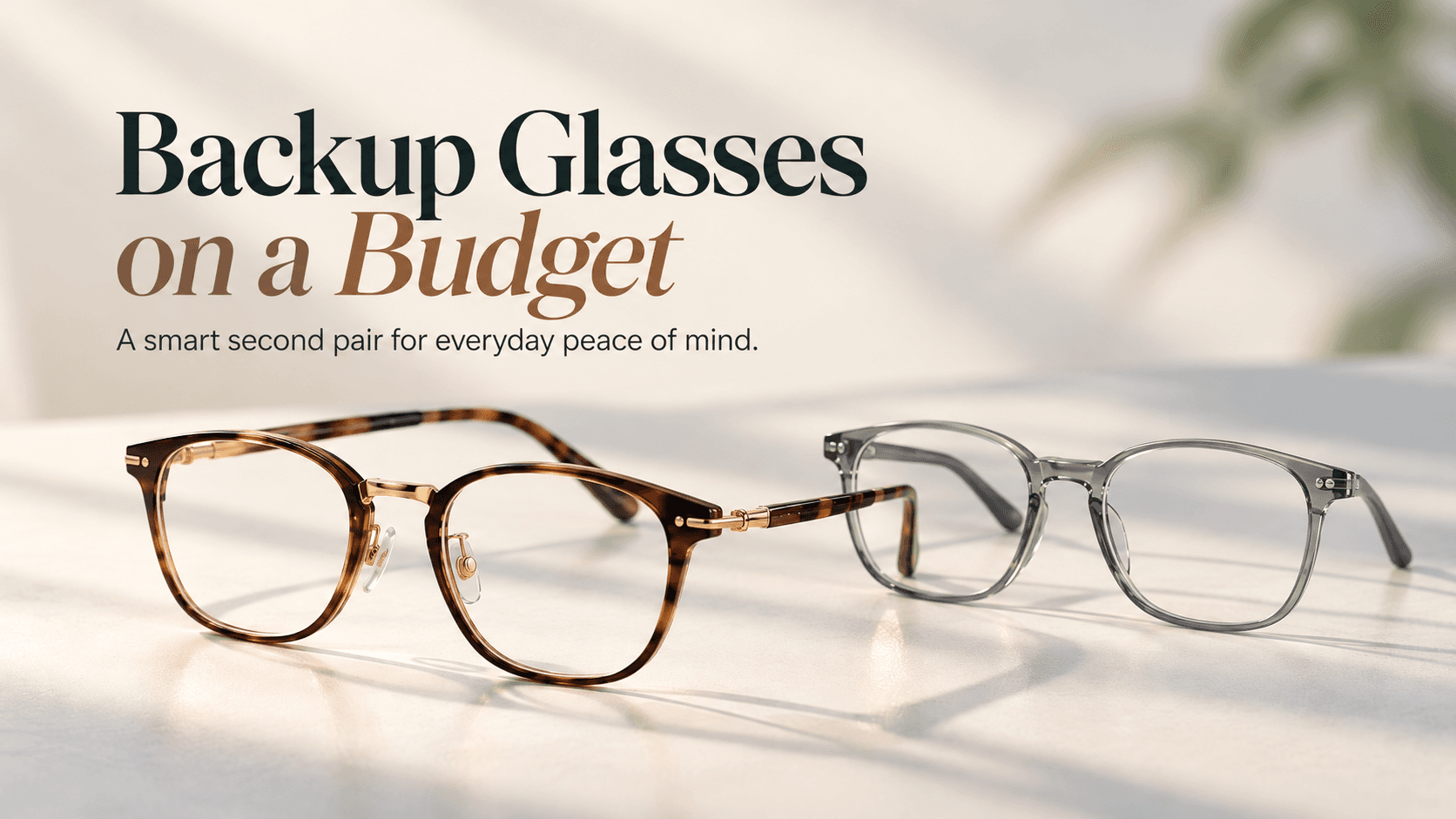
Yes, you need a backup pair of glasses — especially if your prescription is strong or you wear them all day. Losing, breaking, or scratching your only pair can leave you effectively blind for days while replacements are made. A second pair acts as insurance, and with affordable options now available online, there is little reason not to have one.
Why a Backup Pair Is More Important Than You Think
Most people only consider a second pair after a crisis: a snapped frame at 7 AM before a workday, a lost case during travel, or a deep scratch that blurs vision mid-presentation. Optometrists routinely recommend keeping a spare, particularly for anyone with a prescription stronger than ±2.00 diopters, children who are hard on frames, or people who work long hours in front of screens.
There is also a practical maintenance argument. Rotating between two pairs reduces daily wear and tear on each, meaning both last longer. Lenses accumulate micro-scratches over time; giving each pair a rest extends their usable life.
Backup Pair vs. Primary Pair: What Should Be Different?
Your backup does not need to be identical to your primary pair. In fact, it is smarter to choose something complementary. Consider these common pairings:
Primary: rimless or semi-rimless → Backup: full-rim acetate for durability
Primary: fashion frame for office → Backup: lightweight TR-90 frame for travel or sports
Primary: clear lenses → Backup: prescription sunglasses for outdoor use
A prescription sunglass as your backup is especially practical in India, where UV exposure is high year-round. You get a functional second pair and meaningful eye protection in one purchase.
How to Choose a Budget Backup Without Compromising on Quality
Spending less on a backup pair does not mean accepting poor quality. Here is what to prioritise:
Choose polycarbonate or 1.67 high-index lenses — they are thinner, lighter, and impact-resistant, making them ideal for everyday backup use
Stick to full-rim frames — they hold lenses more securely and are less prone to accidental damage
Look for spring hinges — they absorb stress when the frame is opened wide or sat on accidentally
Opt for anti-scratch and anti-reflective coatings — these protect the lenses and reduce eye strain without adding significant cost online
Avoid going too fashion-forward — a neutral, versatile shape means the backup works in any situation
When Does a Backup Pair Make Especially Good Sense?
While everyone benefits from a spare, certain situations make it near-essential. If you travel frequently for work, keep one pair in your carry-on and one in your checked bag. Parents of young children often find that one pair disappears into a toy box or gets sat on within the first month. And if your job involves physical activity, construction, or lab work, a dedicated safety-grade backup is a genuine occupational necessity.
How Much Should You Budget?
A functional backup pair — frames plus single-vision lenses with basic coatings — Progressive or high-index lenses will push the cost higher, but even then, online pricing is significantly lower than in-store equivalents. The key is not to compromise on lens quality to save a few hundred rupees; the frame is the easier place to economise.
