
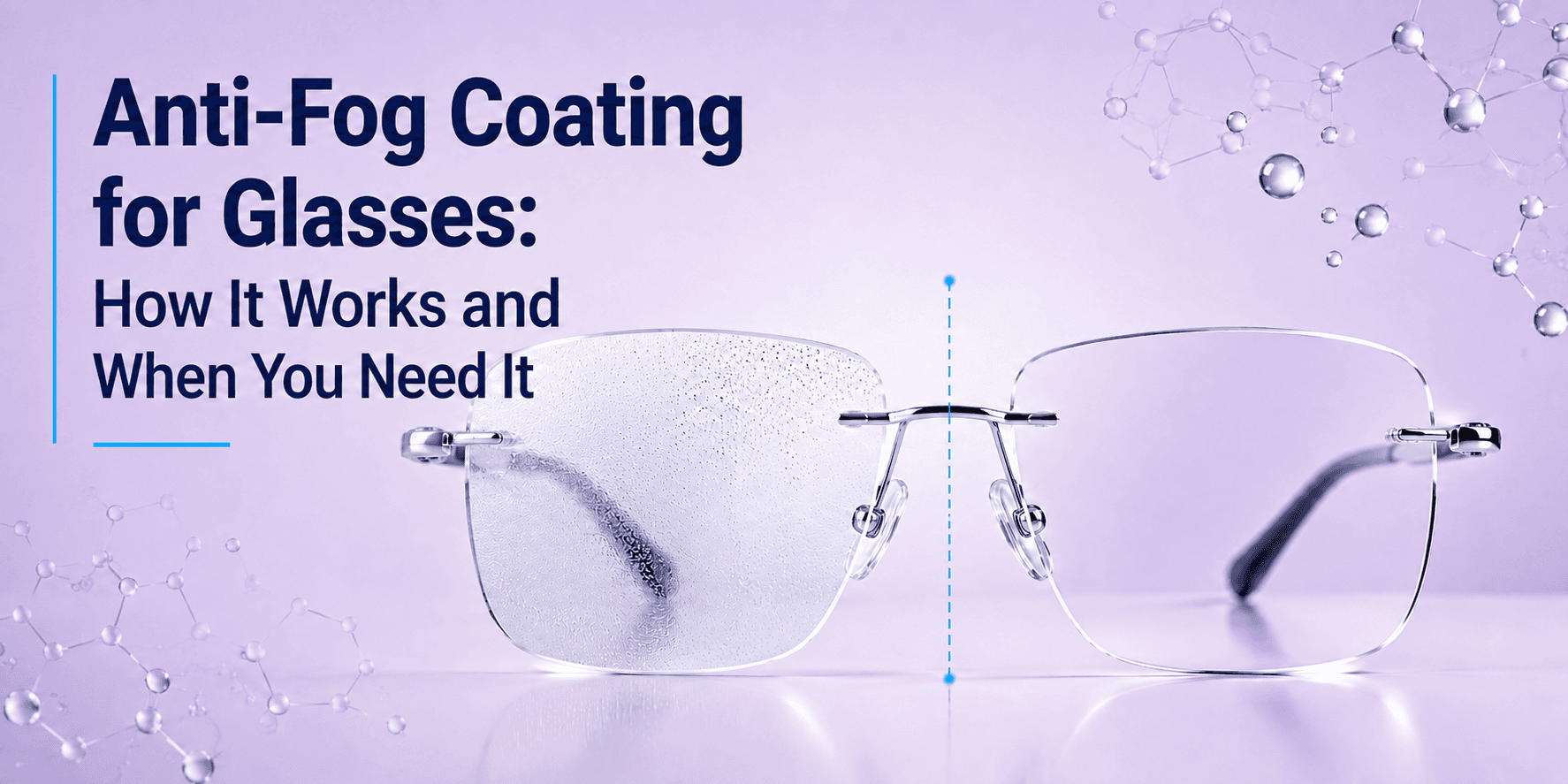
Anti-fog coating prevents lenses from misting over by reducing the surface tension of water droplets, spreading them into a thin, invisible film instead of letting them cluster into vision-blocking fog. It is especially useful for people who move frequently between warm and cool environments, wear face masks, or play sports — and it can be applied as a permanent factory coating or a topical spray.
Why Do Glasses Fog Up in the First Place?
Fogging happens because of a basic physics principle: when warm, humid air meets a cooler lens surface, water vapour condenses rapidly. The tiny water droplets that form scatter light unevenly, making your vision blurry within seconds. This is the same reason a cold glass of water fogs up in a warm room.
For glasses wearers, the triggers are everywhere — walking out of an air-conditioned office into Mumbai's humid heat, entering a kitchen full of steam, or simply breathing through a face mask that directs warm air upward toward your lenses.
How Does Anti-Fog Coating Actually Work?
A standard lens surface is hydrophobic — it repels water, which causes droplets to bead up and scatter light. Anti-fog coating flips this behaviour. It makes the lens surface hydrophilic, meaning water-attracting. Instead of forming thousands of light-scattering beads, moisture spreads into a uniform, near-invisible sheet that does not interfere with your vision.
Permanent anti-fog coatings are bonded to the lens at the manufacturing stage, often as part of a multi-layer coating stack that may also include anti-reflective and scratch-resistant layers. Topical anti-fog sprays and wipes work the same way chemically but wear off after a few cleanings and need to be reapplied regularly.
Permanent Coating vs. Topical Spray: Which Should You Choose?
Both options have a clear use case, and the right choice depends on how often you experience fogging and how much maintenance you are willing to do.
Permanent factory coating — Built into the lens during production. Lasts the lifetime of the lens with normal care. Best for people who fog up daily or who need consistent clarity during work (surgeons, cooks, lab technicians).
Topical anti-fog spray or wipe — Applied at home whenever needed. Affordable and flexible, but must be reapplied every few days or after each cleaning. Best for occasional fogging, travel, or as a quick fix on existing glasses.
If you are ordering a new pair of prescription glasses, adding a permanent anti-fog layer at the time of purchase is almost always more cost-effective than buying topical products repeatedly over a year.
Who Needs Anti-Fog Coating the Most?
Almost any glasses wearer can benefit, but certain situations make it nearly essential.
Mask wearers — exhaled air rises directly onto lenses, causing near-constant fogging
People who commute between air-conditioned and outdoor environments in high-humidity cities
Gym-goers and athletes whose body heat and sweat raise the moisture level around their face
Kitchen workers, bakers, and home cooks who work near steam or boiling water
Healthcare professionals who wear surgical or N95 masks for long shifts
Children in school — frequent transitions between classrooms, playgrounds, and canteens
Travellers moving through airports, cold-storage sections of supermarkets, or hill-station climates
Does Anti-Fog Coating Affect Lens Clarity or Other Coatings?
A well-applied permanent anti-fog coating is optically neutral — it does not change the refractive index of the lens or distort your prescription. It can, however, interact with other coatings. Most premium lenses today combine anti-fog with anti-reflective (AR) and UV protection layers in a single multi-coat stack, which is both practical and space-efficient on the lens surface.
One thing to keep in mind: some older anti-fog formulations made lenses slightly more susceptible to smudging because hydrophilic surfaces attract oils as well as water. Modern coatings address this by adding an oleophobic (oil-repelling) top layer, so your lenses stay clear from both moisture and fingerprints.
How to Care for Anti-Fog Coated Lenses
Anti-fog coatings, like all lens coatings, need gentle handling to last.
Clean with a microfibre cloth and a lens-safe cleaning solution — avoid paper towels or clothing fabric
Rinse lenses under lukewarm (not hot) water before wiping to remove abrasive particles
Avoid silicone-based or alcohol-heavy cleaning products, which can degrade the hydrophilic layer over time
Store glasses in a hard case when not in use to prevent surface scratches that compromise any coating
If using a topical spray, apply it to a clean, dry lens and buff gently — never spray directly onto a dirty lens
Is Anti-Fog Coating Worth the Extra Cost?
For most Indian glasses wearers, yes. India's climate swings — from intensely air-conditioned malls and offices to hot, humid streets — create near-perfect fogging conditions multiple times a day. Add widespread mask use and increasing gym culture, and the value of clear, fog-free vision compounds quickly. The cost of a permanent anti-fog upgrade at the time of purchase is typically a fraction of what you would spend on topical sprays over a year, and the experience is significantly more reliable.
If you are already investing in good lenses — whether single-vision, progressive, or high-index — anti-fog coating is one of the smartest additions you can make for everyday comfort.
