
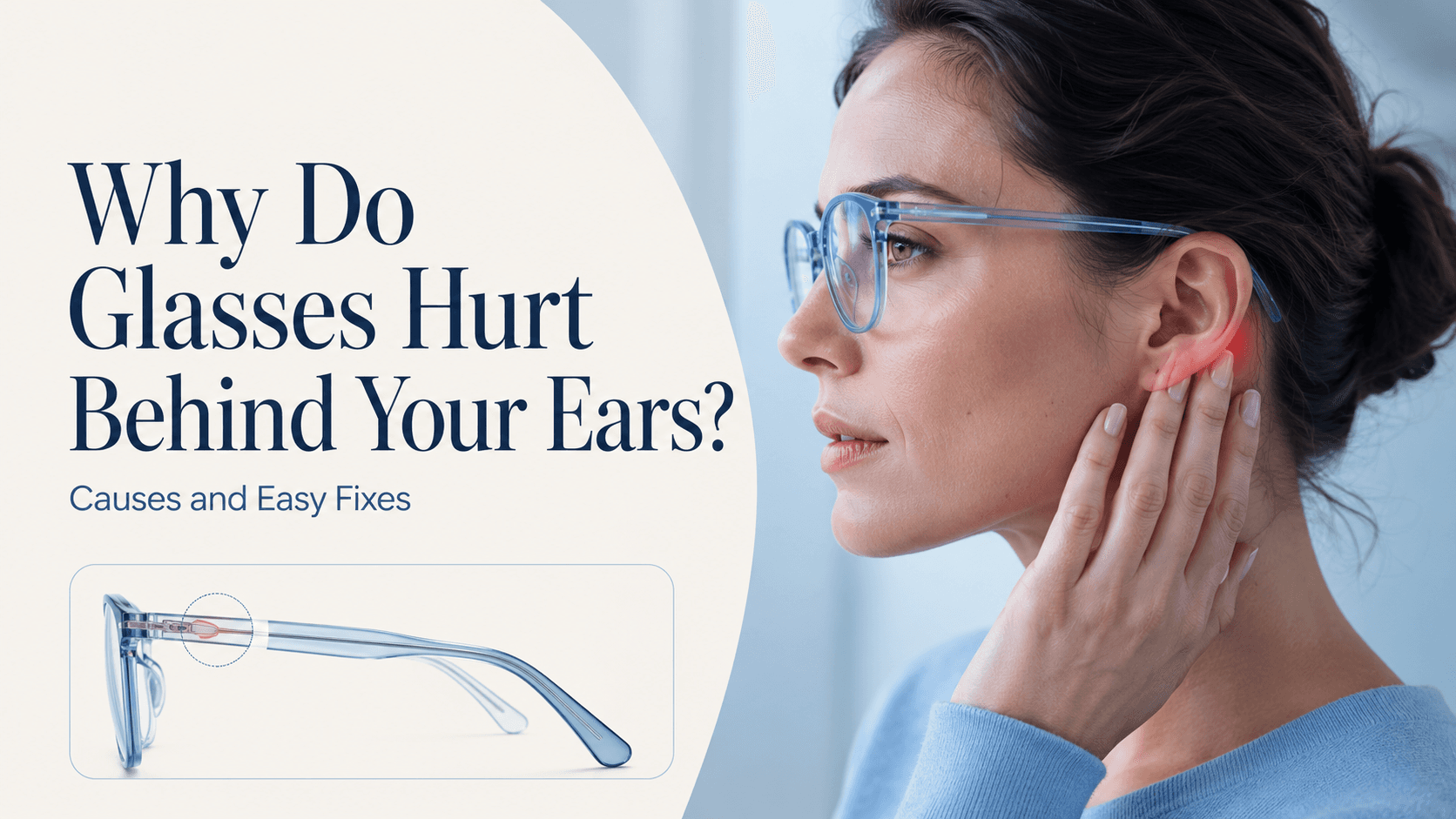
If your glasses dig into the skin behind your ears, the most likely culprit is a misaligned or too-tight temple arm. In most cases, a simple adjustment at an optician — or even at home with the right technique — eliminates the pain entirely. Understanding exactly why the pressure happens helps you fix it faster and stop it from coming back.
What Causes Glasses to Hurt Behind Your Ears?
The discomfort almost always comes down to fit. Glasses are precision instruments that sit on three contact points: the bridge of your nose and the two spots where the temples rest behind your ears. When any one of those points is off, pressure builds up and causes soreness over time.
Temple Arms That Are Too Tight
The most common reason is that the temple arms squeeze too firmly against the sides of your head. This forces the tips — the curved ends that hook behind your ears — to press harder into the skin. Even a millimetre of excess tension repeated across a full day of wear creates noticeable pain.
Temple Tips Bent at the Wrong Angle
The curved section of the temple tip is supposed to follow the natural contour behind your ear and rest gently on the mastoid bone. If the bend is too sharp, too shallow, or starts too early or too late relative to your ear position, the hard plastic or metal edge digs into soft skin. This is especially common with off-the-shelf frames that have not been adjusted to your specific head shape.
Frames That Are Too Heavy
Heavier frames — thick acetate styles or metal frames with large lenses — put more downward force on both the nose and the ears. The temple tips bear a larger share of that weight when the nose pads are not fitted correctly, amplifying pressure behind the ears.
High-Prescription Lenses Adding Weight
If you wear a strong prescription, your lenses are likely thicker and heavier than standard lenses. This extra weight shifts more load onto the temple contact points, making comfort-fit adjustments even more important for prescription eyeglass wearers.
Skin Sensitivity or Allergy
Sometimes the issue is not mechanical pressure but a reaction to the temple material. Nickel in metal frames or certain plastics can irritate sensitive skin, causing redness and soreness that mimics pressure pain. If your discomfort is accompanied by itching or a rash, a material allergy may be the real cause.
How Do You Know If It Is a Fit Problem or Something Else?
Check where exactly the pain sits. Pain directly on the bony ridge behind the ear is almost always a mechanical fit issue. Redness, itching, or a rash in the same area points more toward a material sensitivity. Soreness that spreads to the temples or jaw could indicate that the frames are too tight across the entire width of your head.
Easy Fixes You Can Try at Home
1. Gently Bend the Temple Tips Outward
If your glasses are made from acetate or thick plastic, run the temple tips under warm (not boiling) water for 20–30 seconds to soften them slightly, then carefully bend the tips outward to reduce lateral pressure. Hold them in the new position for 30 seconds while they cool. Do this gradually — over-bending can crack the frame.
2. Adjust the Downward Angle of the Tip
The hook of the temple tip should drop gently downward and follow the slope behind your ear. If the tip is pointing straight back rather than angling downward, it will rest on top of your ear rather than cradling it, creating a pressure point. A gentle downward bend corrects this immediately.
3. Add a Silicone Temple Tip Cover
Soft silicone sleeves that slip over the existing temple tips are available at most optical shops and online. They add cushioning, reduce friction, and can temporarily solve discomfort while you arrange a proper professional adjustment. They cost very little and work surprisingly well as a short-term solution.
4. Visit an Optician for a Professional Adjustment
Most optical stores — including Rimloo's partner fitting partners — will adjust your frames at no charge. A trained optician uses professional heating tools and precise bending to reshape the temple arms, align the nose pads, and balance the frame on your face. If home fixes have not worked after a couple of tries, this is always the right next step.
When Should You Consider Replacing Your Frames?
If your frames are old and the material has become brittle, repeated bending risks snapping them. Similarly, if you have adjusted them multiple times and the discomfort keeps returning, the frame shape may simply not be suited to your head anatomy. In that case, it is worth exploring a different frame style altogether.
Lightweight frame materials like titanium, TR-90 flexible nylon, and thin acetate reduce the load on the ear contact point significantly. If you have consistently struggled with ear pain, prioritising a lightweight frame at your next purchase is the most durable solution.
Tips for Preventing the Problem When Buying New Glasses
Getting the fit right from the start saves a lot of discomfort later. Keep these points in mind when you choose your next pair.
Choose frames whose temple length matches the distance from your hinge to behind your ear — standard lengths are 135 mm, 140 mm, and 145 mm.
Opt for lightweight materials, especially if you have a high prescription.
Ask for a fitting adjustment immediately after your frames arrive, before you wear them all day.
If you have narrow or wide head measurements outside the average range, look for brands that offer size variants.
Consider silicone nose pads that distribute weight more evenly, reducing the load the ears have to carry.
Does Frame Style Affect Ear Comfort?
Yes — frame shape and size influence how weight is distributed. Large, wide frames with heavy lenses concentrate more force on the ear tips. Rimless and semi-rimless frames tend to be lighter, as do frames with smaller lens diameters. If style is important to you, you do not have to sacrifice it, but factoring in weight when choosing between two styles you like equally is a smart move for long-term comfort.
Ultimately, glasses that hurt behind your ears are almost never something you have to simply live with. The fix is usually quick, inexpensive, and permanent once you identify the correct cause.
