
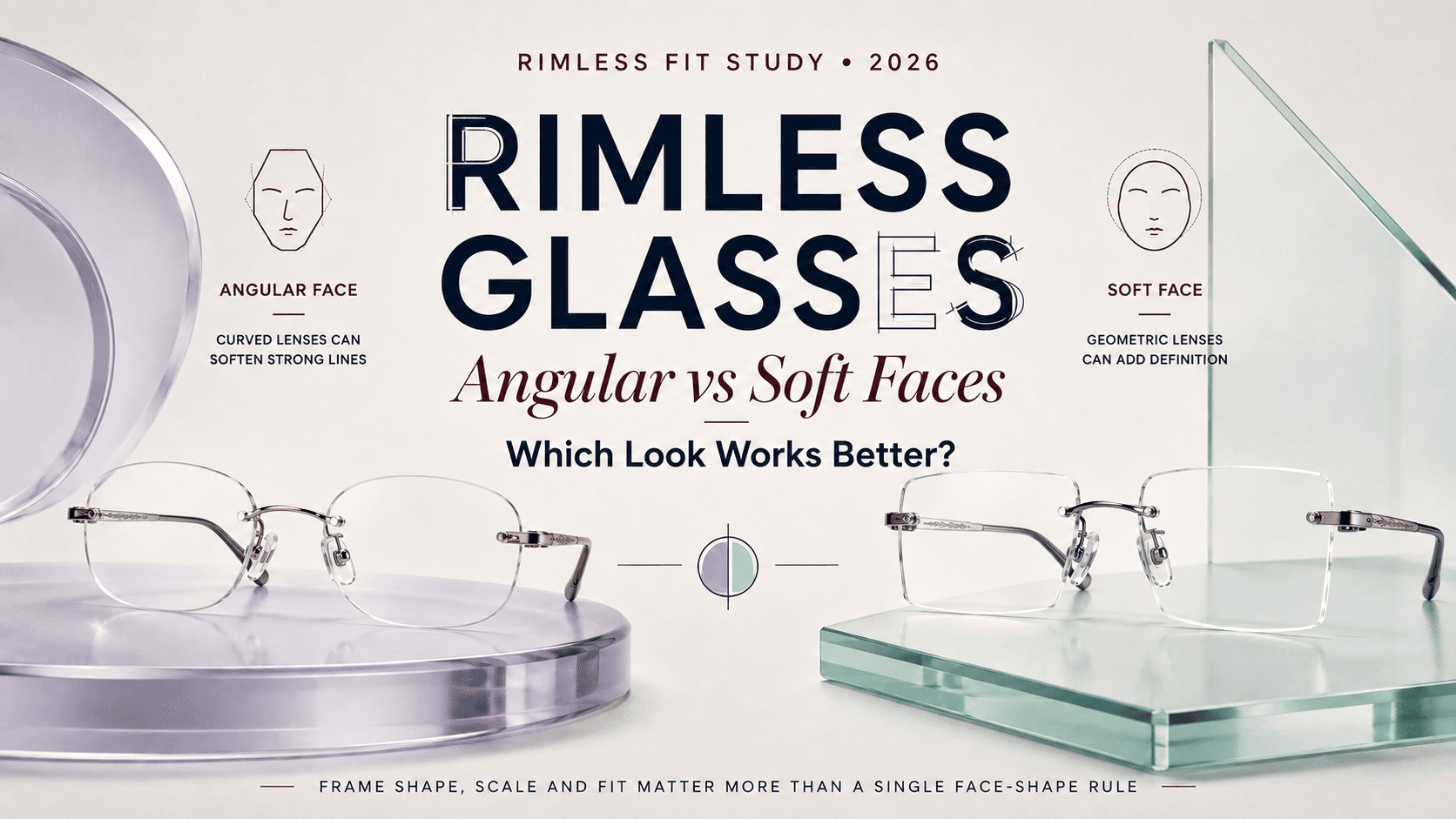
Rimless glasses suit almost every adult face shape, but they work best when matched thoughtfully to your facial geometry. On angular faces, rimless frames soften strong lines without competing with them. On soft, rounded faces, they maintain a clean look but need the right lens shape to add definition. The short answer: both face types can wear rimless — the difference lies in the lens shape you choose.
What Makes a Face "Angular" vs "Soft"?
An angular face has clearly defined jawlines, prominent cheekbones, or sharp temples — think square, rectangle, or diamond face shapes. A soft face has curved, rounded contours — round and oval shapes are the classic examples. Heart-shaped faces can fall somewhere in between depending on chin and forehead proportions.
How Rimless Glasses Look on Angular Faces
Angular faces tend to be naturally striking, and heavy frames can sometimes make features appear even more severe. Rimless glasses are a near-perfect match here because the absence of a frame border lets your facial structure breathe. The eye and lens become the focal point without adding extra lines or edges.
For square and rectangle faces, an oval or round rimless lens works especially well — the curved shape counterbalances the angularity of the jaw. Diamond faces benefit from wider rimless lenses that add breadth at the eye level. Overall, angular faces have the most to gain from going rimless.
How Rimless Glasses Look on Soft Faces
Round and oval faces are versatile, but rimless glasses require a bit more thought here. Because there is no frame to add structure, a purely round rimless lens on a round face can blend in too seamlessly — making the overall look feel undefined.
The fix is straightforward: choose rectangular, geometric, or slightly angular rimless lenses. These add a subtle edge that creates contrast against soft facial curves, giving the wearer a more polished, put-together appearance. Oval faces are the lucky exception — they can pull off almost any rimless lens shape with ease, since oval proportions are naturally balanced.
Angular vs Soft Faces: Quick Comparison
Angular faces (square, rectangle, diamond): Oval or round rimless lenses work best — they soften strong features without adding bulk.
Soft faces (round): Rectangular or geometric rimless lenses add definition that purely rounded lenses lack.
Oval faces: The most flexible — virtually any rimless lens shape flatters naturally.
Heart-shaped faces: Light rimless frames with a gentle width at the top balance a wider forehead against a narrower chin.
Other Factors That Affect the Rimless Look
Face shape is only part of the equation. Skin tone and hair colour influence how visible (or invisible) a rimless frame appears. Lighter skin tones may find rimless lenses disappear entirely, while darker tones provide a natural contrast that makes the lens shape more legible. Lens tint also plays a role — a subtle photochromic or light tint on rimless lenses can add just enough visual weight to anchor the look on softer faces.
Finally, consider nose bridge fit. Since rimless glasses have no full frame structure, an ill-fitting nose bridge causes the entire pair to sit crookedly. Always prioritise accurate PD (pupillary distance) measurement and nose pad adjustability when buying rimless frames online.
The Bottom Line
Rimless glasses work on both angular and soft faces — but angular faces enjoy the widest range of compatible lens shapes. If your face is soft or round, simply opt for a rectangular or geometric lens cut and you will get the same clean, minimal aesthetic without sacrificing definition.
