
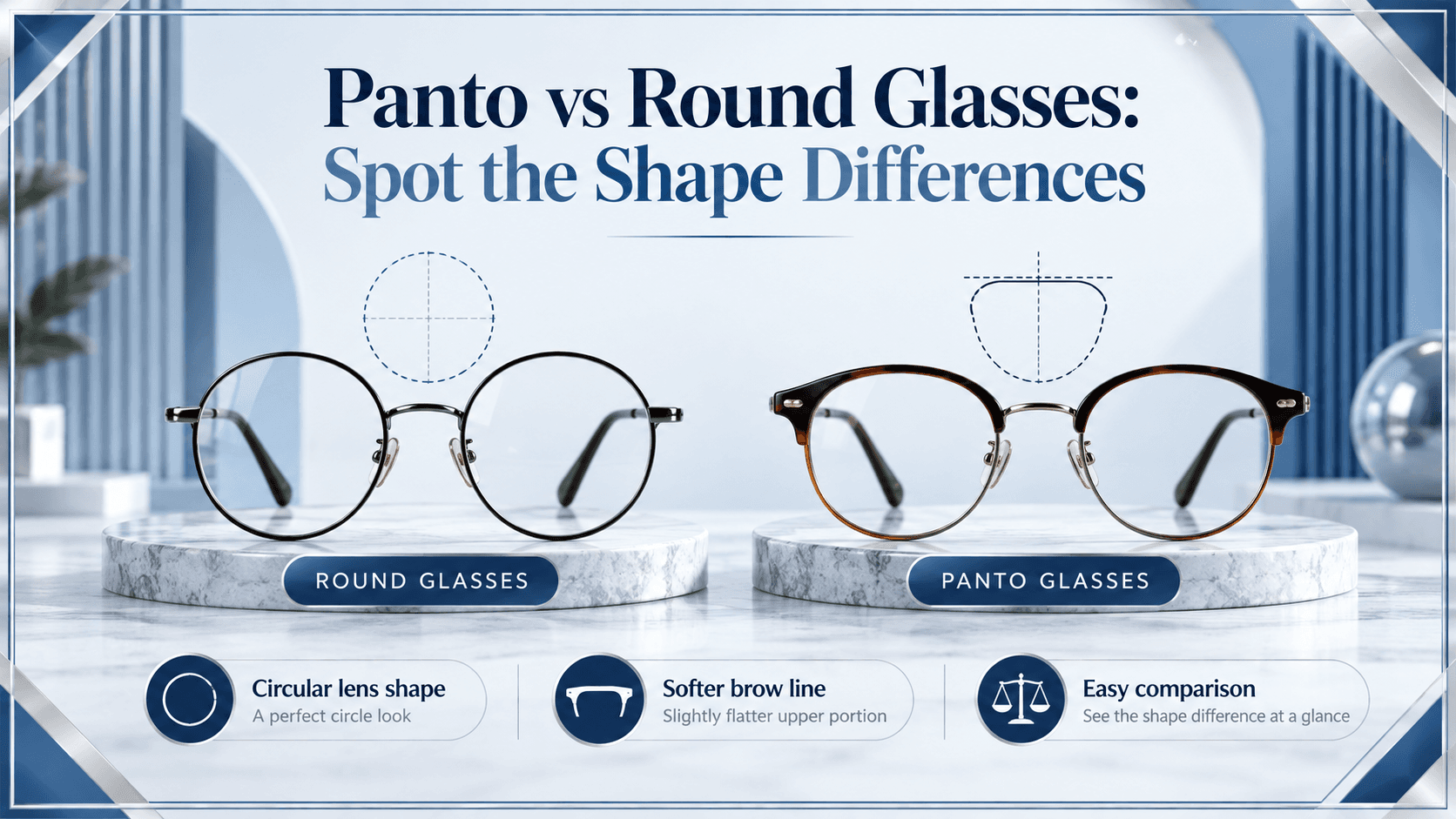
Panto and round glasses are close cousins, but they are not the same shape. A panto frame has a flat or slightly straight top edge with a rounded lower half, giving it a teardrop silhouette. A round frame forms a near-perfect circle. That single difference changes how each shape flatters your face, balances your features, and expresses your personality.
What Makes a Panto Frame Unique?
The word panto is short for pantoscopic, referring to the angled tilt of the lens. Visually, a panto frame is defined by its flat upper rim and softly curved lower rim. The result is an oval-meets-teardrop outline that sits closer to vintage 1960s French style than to classic round spectacles. Because the top edge is straighter, panto glasses add gentle structure to the brow area without looking boxy.
What Makes Round Glasses Distinctive?
Round frames form a full circle — equal width and height on all sides. They are the silhouette most associated with intellectuals, artists, and the Lennon-era counterculture. The continuous curve creates an open, symmetrical look that softens any angles on the face. There is no flat edge to anchor the frame, which gives round glasses a floaty, almost minimalist quality on the face.
Panto vs Round: Key Shape Differences at a Glance
Top edge: Panto has a flatter top; round is uniformly curved all the way around.
Overall silhouette: Panto reads as oval-teardrop; round reads as a geometric circle.
Height-to-width ratio: Panto frames are usually slightly wider than tall; round frames have an equal or near-equal ratio.
Brow coverage: Panto frames follow the brow line more closely; round frames sit independently of brow shape.
Vintage reference: Panto evokes 1960s French and Italian design; round evokes 1970s British and Bohemian aesthetics.
Which Face Shape Suits Each Frame Best?
Panto frames work exceptionally well on oblong and oval faces. The wider lower curve adds visual width to the cheek area, while the flatter top does not over-extend height. Square and rectangular faces also benefit because the rounded bottom softens a strong jaw without fighting the angular forehead.
Round frames are a natural match for square, diamond, and heart-shaped faces. The unbroken curve directly counterbalances sharp angles at the jaw or temples. Oval faces can carry round glasses too, though very petite oval faces should choose a smaller diameter to avoid the frames overwhelming their features.
When to Choose Panto vs Round
Choose panto glasses when you want a retro-chic look that still feels contemporary and structured. They pair well with smart-casual Indian office wear and suit both men and women. Choose round glasses when you want a bold artistic statement or a softer, more eclectic aesthetic. Round frames photograph beautifully and have remained a consistent eyewear style trend across seasons.
Material and Fit Tips for Both Shapes
Both panto and round frames are available in acetate and metal. Acetate versions feel warmer and bolder; metal versions look lighter and more minimal. Whichever shape you choose, ensure the frame width does not extend beyond your temples and the optical centre of the lens aligns with your pupil. A well-fitted frame of either shape always outperforms a stylish but ill-fitting one.
