
The right lens can make the difference between glasses you forget you're wearing and glasses that give you headaches by noon. For most consumers, lens choice comes down to cost and prescription — but material, coating, index, and lens type all shape your daily comfort in ways a frame never can. This guide cuts through the confusion so you can buy smarter.
Why Your Lens Choice Matters More Than Your Frame Choice
Frames sit on your face; lenses sit between you and everything you see. A premium acetate frame with the wrong lens will still leave you squinting, straining, or rubbing your eyes by evening. Lenses determine optical clarity, how heavy your glasses feel, how your eyes respond to screens, and how well you cope with sunlight. Getting the frame right is about style. Getting the lens right is about function — and function has to come first.
Which Lens Material Should You Choose?
Most lenses sold fall into three broad categories. Understanding each one helps you pick with confidence rather than just defaulting to whatever the optician stocks.
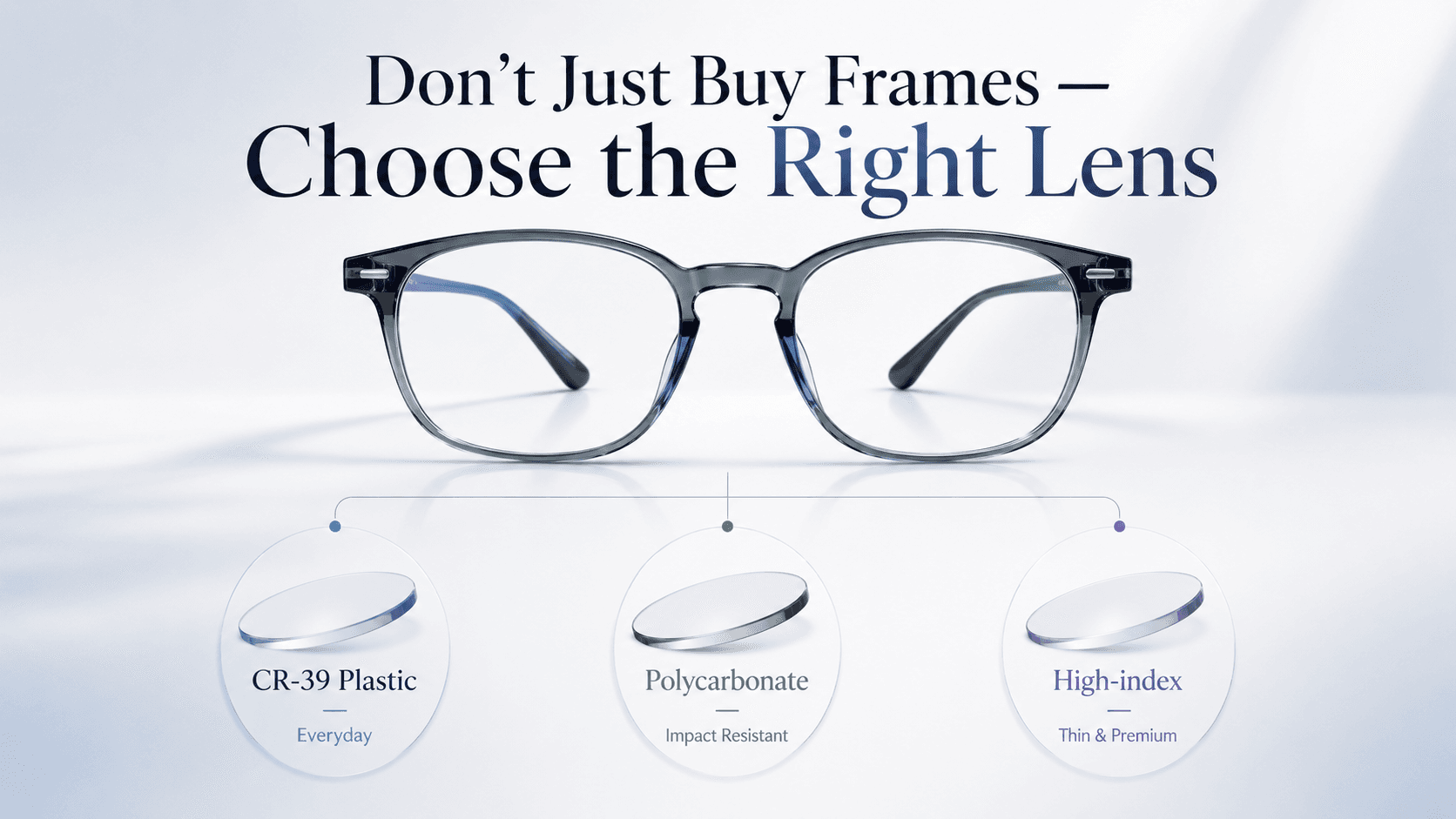
CR-39 plastic — The classic. Affordable, optically excellent, and easy to tint. Best for low-to-moderate prescriptions (up to around ±3.00). Gets thick quickly at higher powers.
Polycarbonate — Impact-resistant and roughly 10 times stronger than CR-39. Lighter than standard plastic. The go-to for children, sports, and rimless or semi-rimless frames where the lens edge bears more stress.
High-index (1.67 / 1.74) — Thinner and lighter than CR-39 at the same prescription power. Essential for anyone with a power beyond ±4.00 who doesn't want lenses that look like glass portholes. Costs more, but the comfort gain is real.
Single Vision, Bifocal, or Progressive — What's the Difference?
Your prescription type dictates the lens design you need, but it's worth understanding what each design actually does.
Single vision — One focal power across the entire lens. Correct for either distance or near vision, not both. Standard for anyone under 40 with a straightforward prescription.
Bifocal — Two distinct zones: distance on top, reading at the bottom, separated by a visible line. Functional and affordable, but the jump between zones can cause visual fatigue.
Progressive (no-line multifocal) — A gradient of powers from distance at the top to near at the bottom, with no visible line. Looks like a single-vision lens, works like a multifocal. The modern standard for presbyopia. There is a learning curve of a few days, but most wearers adapt quickly.
Coatings: The Features You Don't See But Definitely Feel
Bare lenses — even premium ones — are incomplete. Coatings protect the lens surface and enhance the visual experience in ways the prescription alone cannot.
Anti-reflection (AR) coating — Reduces glare from oncoming headlights, office lighting, and screens. Arguably the single most impactful upgrade for daily wear. Non-negotiable if you drive at night or work on a computer.
Blue-light filtering — Blocks a portion of high-energy visible (HEV) blue light emitted by LED screens and fluorescent lighting. Particularly useful if you log six or more hours a day on a phone, laptop, or tablet. Evidence on long-term eye damage from screens is still debated, but reduced glare and improved contrast are consistent user benefits.
UV400 protection — Blocks ultraviolet radiation up to 400 nm. Essential on sunglasses; worth adding to clear lenses too, especially in summer’s hot sunlight conditions. UV exposure accumulates over a lifetime and is linked to cataract risk.
Scratch-resistant coating — Lenses are not scratch-proof, but a hardening coat significantly extends their life. Almost all lenses should carry this as a baseline.
Hydrophobic / oleophobic coating — Repels water, oil, and fingerprints. Makes lenses easier to clean and keeps them clearer in rain or humid conditions.
Photochromic vs. Prescription Sunglasses: Which Is Right for You?

If you move between indoors and outdoors frequently — say, a commute that involves both an office and outdoor travel — you have two practical options.
Photochromic lenses (marketed under brand names like Transitions) darken automatically in UV light and clear indoors. They offer convenience: one pair does both jobs. The trade-off is that they don't darken inside cars (most windshields block the UV that triggers the reaction) and full darkening takes one to two minutes.
Prescription sunglasses give you dedicated, optimised tint from the moment you step outside. Polarised prescription sunglasses also eliminate reflected glare from roads, water, and car bonnets — something photochromic lenses cannot do. If you drive often or spend long stretches outdoors, a separate pair of prescription sunglasses delivers noticeably better comfort and eye protection.
Matching Your Lens to Your Lifestyle
No single lens configuration suits every routine. Think about your actual daily pattern before deciding.
Heavy screen user indoors: single vision or progressive with AR coating and blue-light filter
Frequent driver: AR coating is essential; consider polarised prescription sunglasses for daytime driving
Outdoor professional or frequent traveller: UV400 on all lenses; photochromic or dedicated prescription sunglasses
High prescription (beyond ±4.00): high-index material to reduce weight and thickness
Active lifestyle or sport: polycarbonate for impact resistance; wrap-style frames that hold the lens securely
40+ with near-vision difficulty: progressive lenses over bifocals for seamless vision at all distances
How to Read Your Prescription Before You Buy
A prescription has a few key numbers: SPH (sphere, the main power), CYL (cylinder, for astigmatism), AXIS (the angle of the cylinder), and ADD (reading addition, present in multifocal prescriptions). The higher the absolute value of SPH or CYL, the more you stand to benefit from high-index lenses. If your CYL is significant, lens placement accuracy matters — always verify that your pupillary distance (PD) measurement is included on your prescription or measured at purchase.
The Bottom Line
Frames express who you are. Lenses determine how clearly you see the world and how comfortable your eyes feel doing it. The best eyewear purchase combines both decisions thoughtfully — starting with the lens requirements your lifestyle demands, then finding a frame that complements them. At Rimloo, every order can be configured with the lens type and coatings that match your prescription and daily routine, so you're not just buying glasses — you're building the right pair.
