
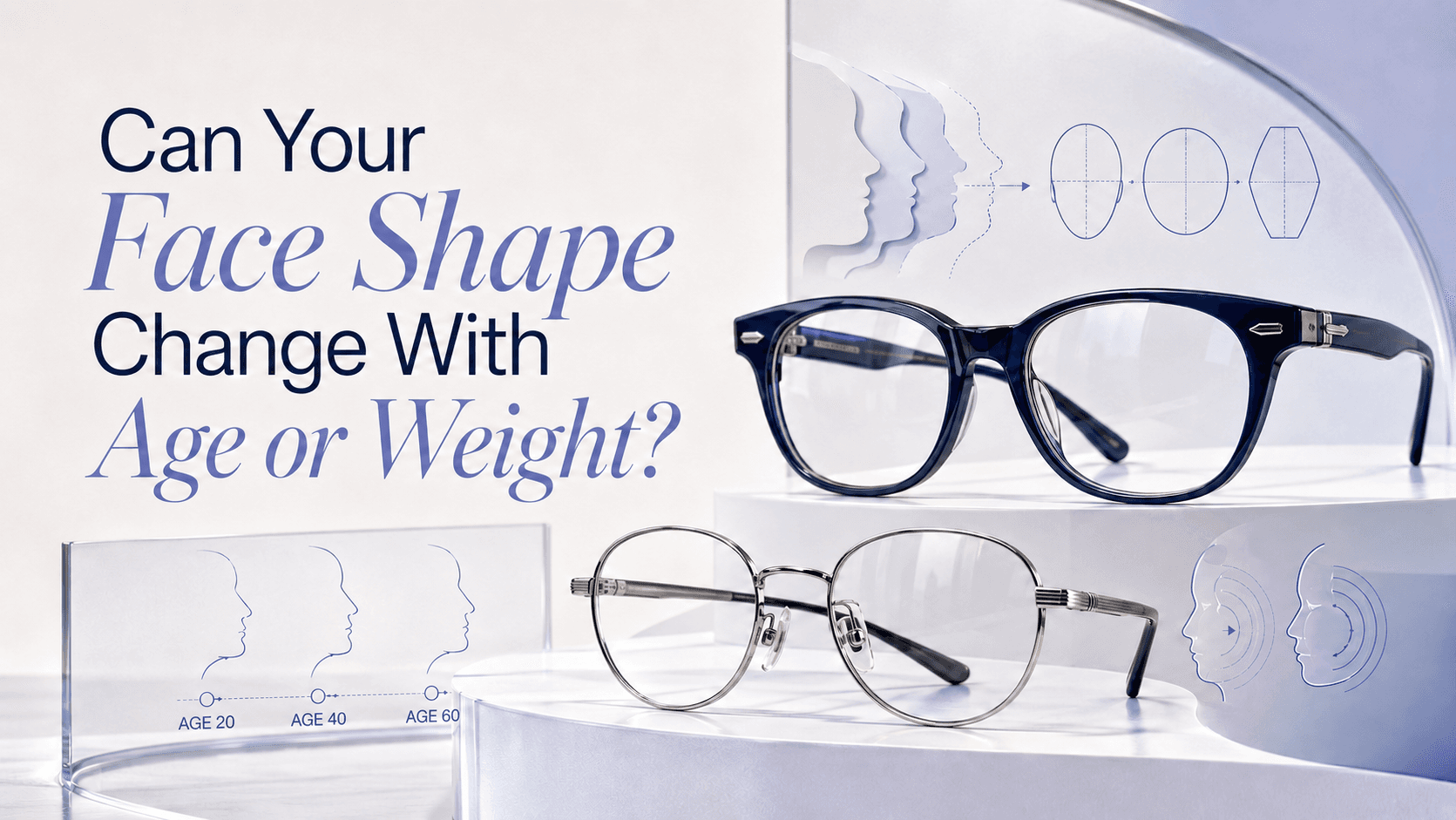
Yes, your face shape can change — and more significantly than most people realise. Ageing causes bone density shifts, collagen loss, and fat redistribution, while weight gain or loss directly alters facial fullness and contour. If your current frames feel 'off' even though they once looked great, your face may have quietly changed shape on you.
How Does Ageing Change Your Face Shape?
As you move through your thirties and beyond, several structural changes alter your facial silhouette:
Bone resorption: The jaw, cheekbones, and eye sockets gradually lose density, softening previously sharp angles. A once-square jaw can begin to appear more oval or heart-shaped.
Collagen and elastin loss: Skin loses its firmness, causing cheeks to descend slightly and jowls to form. This can make a round face appear more square at the lower third.
Fat pad migration: Facial fat pads thin and shift downward with age, hollowing the temples and mid-face while adding volume around the lower jaw.
Brow and lid drooping: The forehead and brow area can appear wider or heavier, changing your face's overall proportion.
The combined effect means that a face that was oval at 28 may read as more oblong or rectangular by 45. Updating your frame choice to reflect this is not vanity — it is good styling sense.
How Does Weight Change Affect Face Shape?
Weight changes tend to show up on the face quickly. Gaining weight typically adds fullness to the cheeks, chin, and jawline, shifting a face toward rounder or fuller proportions. Losing weight does the reverse — sharpening angles, making cheekbones more prominent, and elongating the overall appearance of the face.
Even a change of 5–8 kg can noticeably alter whether angular frames or softer, rounded ones look more balanced on you. If you have lost or gained weight recently and your glasses suddenly seem to dwarf or disappear on your face, your face shape may be the reason.
Which Frame Styles Work Best as Your Face Shape Shifts?
The core rule stays constant: choose frames that contrast your face's dominant geometry. What changes is which geometry is actually dominant now.
Fuller, rounder faces: Angular frames — rectangles, wayfarers, or geometric shapes — add definition. Avoid very round or small oval frames that amplify fullness.
Longer or more oblong faces: Wide, deep frames (oversized squares or aviators) reduce the appearance of length. Avoid tall, narrow frames.
Softer, more heart-shaped faces: Bottom-heavy frames like club masters or light rimless styles balance a wider forehead against a narrower chin.
Sharper, more angular faces: Rounded or oval frames soften hard lines without erasing structure.
When Should You Reassess Your Frame Choice?
A good rule of thumb: re-evaluate your frame style every three to five years, or whenever you notice a significant change in your weight, prescription strength, or overall facial appearance. Your optometrist or an eyewear stylist can help you identify your current face shape objectively — which is harder to do yourself in a mirror.
At Rimloo, every product page includes face-shape guidance so you can filter frames that genuinely suit your current look, not the one from five years ago.
